This is a historic letter, published in France’s “newspaper of record”, Le Monde, just over 45 years ago. Source article here.
********************
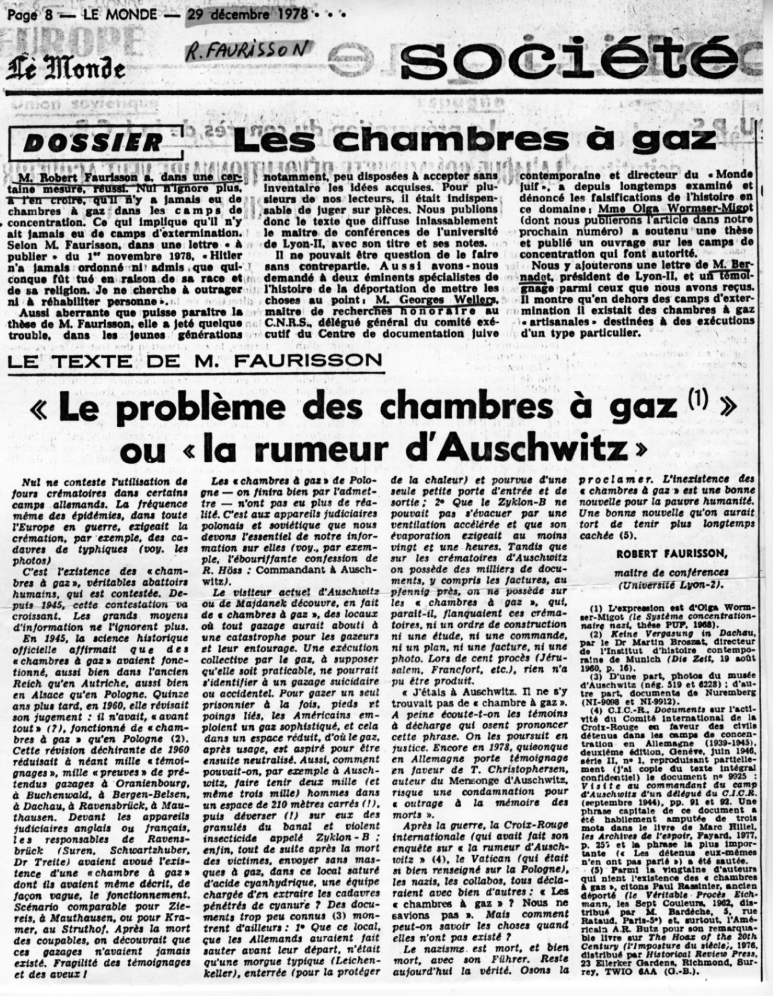
Letter to Le Monde published on December 29, 1978
“The Problem of the Gas Chambers [1]“ or “The Rumour of Auschwitz”
No-one questions the use of crematoria in certain German camps. The mere frequency of epidemics throughout Europe at war demanded the cremation, for example, of the bodies of typhus victims (see photographs).
It is the existence of “gas chambers”, veritable slaughterhouses for humans, that is called into question. Since 1945, the questioning has been growing. The mass media are aware of this fact.
In 1945, the official historiography affirmed that the “gas chambers” had been used in the former (pre-1938) Reich as well as in Austria, in Alsace as well as in Poland. Fifteen years later, in 1960, it revised its judgment: “gas chambers” had operated, “first and foremost” (?), only in Poland [2]. This drastic revision of 1960 reduced to naught a thousand “testimonies”, a thousand “proofs” of alleged gassings at Oranienburg, at Buchenwald, at Bergen-Belsen, at Dachau, at Ravensbrück, at Mauthausen. Appearing before British or French judicial bodies, the heads of Ravensbrück camp (Suhren, Schwarzhuber, Dr Treite) had admitted the existence of a “gas chamber” whose functioning they had even, in a vague manner, described. A comparable scenario had been acted out by Ziereis, of Mauthausen, or by Kramer, of Struthof. After the deaths of those condemned men it was discovered that those gassings had never taken place. Flimsiness of testimonies and confessions!
The “gas chambers” of Poland — as will surely be admitted in time — had no more reality about them. It is to the Polish and Soviet judicial bodies that we owe most of our information on them (see, for instance, the horrifying confession of R. Höss: Commandant of Auschwitz).
Today’s visitor to Auschwitz or Majdanek discovers, in the way of “gas chambers”, facilities in which any gassings would have spelt catastrophe for the gassers and their entourage. A collective execution by gas, supposing that it were practicable, could not at all be likened either to a suicidal or to an accidental gassing. In order to gas a single convict at a time, with his wrists and ankles shackled, the Americans employ a special gas [hydrogen cyanide] within a small space, from which, after its use, it is extracted and subsequently neutralised. So then, how could two thousand people (and even three thousand) be held in an enclosure of 210 square metres (!), at Auschwitz, for example, to have a common and powerful insecticide called Zyklon B poured onto them (!); finally, just after the victims’ death, how could a team be sent, without gas masks, into that place saturated with hydrogen cyanide in order to remove the cyanide-infused corpses? Some too little-known documents [3] show, moreover: 1) That the structure in question, which the Germans are said to have blown up shortly before their departure, was nothing but a typical morgue (Leichenkeller), built underground (to protect it from the warmth of the air) and fitted with a single small door for entry and exit; 2) That the Zyklon B could not be evacuated by a rapid ventilation and that it needed at least twenty-one hours to evaporate. Whereas thousands of documents on the Auschwitz crematoria (including invoices precise to the last Pfennig) are in our possession, neither a directive to build, nor a study, nor an order for building materials, nor a blueprint, nor a bill, nor any photograph is attested as regards the “gas chambers”, which, we are told, adjoined those crematoria. At a hundred trials (Jerusalem, Frankfurt, etc.), no evidence has been produced.
“I was at Auschwitz. There were no ‘gas chambers’ there.” Those who dare to bear witness on behalf of the accused by pronouncing that sentence are hardly listened to. They are prosecuted. Still in 1978, anyone in Germany who speaks out in favour of Thies Christophersen, author of Die Auschwitz-Lüge (“The Auschwitz Lie”), risks a conviction for “offending the memory of the dead”.
After the war, the International Red Cross (which had investigated “the rumour of Auschwitz”) [4], the Vatican (which had been quite well informed about Poland), the Nazis, the collabos, all declared, along with many others: “The ‘gas chambers’? We did not know.” But how can anyone know of things that have not existed?
Nazism is dead and gone, together with its Führer. There remains today the truth. Let us dare to tell it publicly. The non-existence of the “gas chambers” is good news for humanity. Good news that it would be wrong to keep hidden any longer [5].
December 29, 1978
___________
Notes
[1] The phrase is that of Olga Wormser-Migot (Le Système concentrationnaire nazi, thesis published by the Presses Universitaires de France, Paris 1968).
[2] “Keine Vergassung in Dachau”, by Dr Martin Broszat, director of the Institute of Contemporary History in Munich (Die Zeit, August 19, 1960, p. 16).
[3] On the one hand, photos from the Auschwitz Museum (negatives 519 and 6228), and, on the other hand, papers from the Nuremberg trial (NI-9098 and NI-9912).
[4] See Documents relating to the work of the International Committee of the Red Cross for the benefit of civilian detainees in German concentration camps between 1939 and 1945, Geneva 1975 [French edition 1946] reproducing in part (I have a copy of the full confidential text) document No. 9925: “Visit by an ICRC delegate to the Commandant of Auschwitz Camp (September 1944)”, p. 76-77 [French edition, p. 91-92]. A crucial sentence of this document was deftly truncated of three words in the book by Marc Hillel, Les Archives de l’espoir (“The Archives of Hope”), Fayard, Paris 1977, p. 257, and the most important sentence (“The inmates themselves said nothing [about a gas chamber]”) was simply left out.
[5] Among the score of authors who refute the existence of the “gas chambers”, I shall cite Paul Rassinier, wartime deportee (Le Véritable Procès Eichmann, Les Sept Couleurs, Paris 1962, distributed by Maurice Bardèche, 5, rue Rataud, 75005 Paris) and, especially, the American A. R. Butz for his remarkable book on The Hoax of the 20th Century, 1976, distributed by the Historical Review Press [fourth paperback edition, corrected and expanded, 2015].

3 Responses
In Deutschland haben wir ein Sprichwort: “Wer einmal lügt, dem glaubt man nicht – und wenn er auch die Wahrheit spricht.” Wenn wir in unserer Lebenszeit etwas gelernt hätten, nämlich daß es eine sich spreizende Gabel von der erlebten und uns bezeugten Geschichte zur offiziellen Geschichtserzählung gibt. Je mehr Einzelheiten wir mit wissenschaftlich-kritischer Methode unter die Lupe nehmen, desto größer werden die Widersprüche und logischen Diskrepanzen, desto fragwürdiger die behaupteten Sachverhalte. Es wäre als hätte sich die Zeit in Parallelen aufgespalten, in miteinander nicht mehr vergleichbare Universen. Menschliche Lügner sind nicht besonders erfindungsreich und ihnen mangelt es an Überblick und Kenntnis. Fälschung ist eine den Menschen in seiner Beschränktheit überfordernde Angelegenheit. Dazu kommt allgemein die Verfallszeit der Lüge, jedoch die Ewigkeit der Wahrheit. Große Zusammenhänge lassen sich darum besonders schlecht fälschen, also geschichtliche Rahmenhandlungen und Epochen. Am besten geht es noch, wenn die Tatsachen im Moment schon gefälscht sind. Sie sind leichter in die Geschichte einzufügen als Märchen und Sagen vom Hörensagen. Das Volk muß allerdings in einer Art geistigen Umnachtung gehalten werden. Ich persönlich bin zu der Schlußfolgerung gekommen, daß mir nahestehende Überlebende am glaubhaftesten schildern können, was wirklich geschah. Auf dieser Grundlage vermag ich, die weitere Prüfung auf Plausibilität vorzunehmen. Da die frühesten mir übermittelten Berichte aus der Kindheit meiner Urgroßmutter stammen, sie aber auch das Leben ihrer Eltern teilweise überblickte, komme ich zu fünf Generationen. Das wären etwa 125 Jahre von mir wirklich verstandener Geschichte. Die Historikerzunft ist mir dabei insgesamt unsympathisch geworden. Interessant ist, daß besonders Nichthistoriker zur Revision jedweder Historie taugen. Damit bezweifele ich auch, daß die Römer in der behaupteten Form lebten. Die Hochkultur auf deutschem Boden jedenfalls halte ich eher für germanisch und vielleicht teils noch keltisch und slawisch, jedenfalls nicht für römisch. Dazu paßt das Herrschaftsgebiet des sogenannten Heiligen Römischen Reiches Deutscher Nation. Damit wären Augsburg, Regensburg, Köln und Worms urdeutsche Städte. Wer den Hellweg bis in den Fernen Osten als Handelsweg betrieb, hätte nicht rechnen und schreiben können? Das alles ist eine lächerliche Behauptung. Ich habe Anlaß zu glauben, daß besonders die Geschichte der Germanen stark verzerrt wurde. Man will uns nur davon überzeugen, daß wir immer schon Sklaven gewesen wären, weil man uns unsere Hochkultur ausreden will und die Erinnerung an bessere Zeiten, damit der Sklave sich nicht zum Herren erhebt. Wer einmal erweckt wurde, kann nie wieder darüber einnicken. Dunkle Kräfte verlieren die Kraft im blendend hellen Lichtschein unseres Bewußtseins und Herzens. Je mehr Geschichtslügen enttarnt werden, desto weniger kann man sie per Gesetz schützen. Lügner haben auf immer ihren Status als Autoritäten eingebüßt, und das macht mich froh.
Translation of Hilken’s comment:
In Germany, we have a saying: “Once a liar, always a liar – even when they speak the truth.” If there is one thing we have learnt in our lifetime, it is that there is a growing divergence between the history we have experienced and witnessed, and the official historical narrative. The more details we scrutinise using scientific and critical methods, the greater the contradictions and logical discrepancies become, and the more questionable the alleged facts appear. It is as if time had split into parallel streams, into universes that can no longer be compared with one another. Human liars are not particularly inventive and lack both perspective and knowledge. Fabrication is a task that overwhelms human beings in their limited capacity. Added to this is the fact that lies generally have a shelf life, whereas the truth is eternal. Broad contexts are therefore particularly difficult to fabricate – that is, historical frameworks and eras. It works best when the facts are already fabricated at the time they occur. They are easier to weave into history than fairy tales and legends based on hearsay. The people, however, must be kept in a state of intellectual bewilderment. I have personally come to the conclusion that survivors close to me are best placed to describe credibly what really happened. On this basis, I am able to carry out a further examination of plausibility. Since the earliest accounts passed down to me date from my great-grandmother’s childhood, though she also had some insight into her parents’ lives, this takes me back five generations. That would amount to some 125 years of history that I truly understand. In the process, I have come to find the historical profession as a whole rather unsympathetic. It is interesting that non-historians, in particular, are well-suited to revising any history. Consequently, I also doubt that the Romans lived in the manner claimed. In any case, I regard the advanced civilisation on German soil as being more Germanic and perhaps partly Celtic and Slavic as well; certainly not Roman. This is consistent with the territory of the so-called Holy Roman Empire of the German Nation. This would make Augsburg, Regensburg, Cologne and Worms ancient German cities. Could anyone who operated the Hellweg as a trade route all the way to the Far East really have been unable to count or write? All of this is a ridiculous claim. I have reason to believe that the history of the Germanic peoples, in particular, has been severely distorted. They merely wish to convince us that we have always been slaves, because they want to talk us out of our advanced civilisation and erase the memory of better times, so that the slave does not rise to become a master. Once awakened, one can never slumber again. Dark forces lose their power in the dazzling light of our consciousness and hearts. The more historical lies are exposed, the less they can be protected by law. Liars have forfeited their status as authorities for ever, and that makes me glad.
Beautiful comment!