by John Wear, on Wear’s War website, source article here.
Rudolf Hess (1894-1987) was one of the most popular National Socialist leaders. Albrecht Haushofer, who was one-quarter Jewish and abhorred National Socialism, wrote in 1934 about Hess: “There is a strange charm in his personality; whenever he is there, a friendly veil falls over all the grey and black of the present.”[1] After meeting Hitler’s inner circle for the first time on April 13, 1926, Joseph Goebbels wrote about Hess in his diary:
“Hess—the most decent person, quiet, friendly, reserved: the private secretary.”[2]
Hess is also famous for his flight to Great Britain on May 10, 1941 to attempt to negotiate peace with the British. This article discusses Hess’s motives for this dangerous flight, the injustice against Hess at the Nuremberg Trial, and whether Hess committed suicide or was murdered in Spandau Prison.
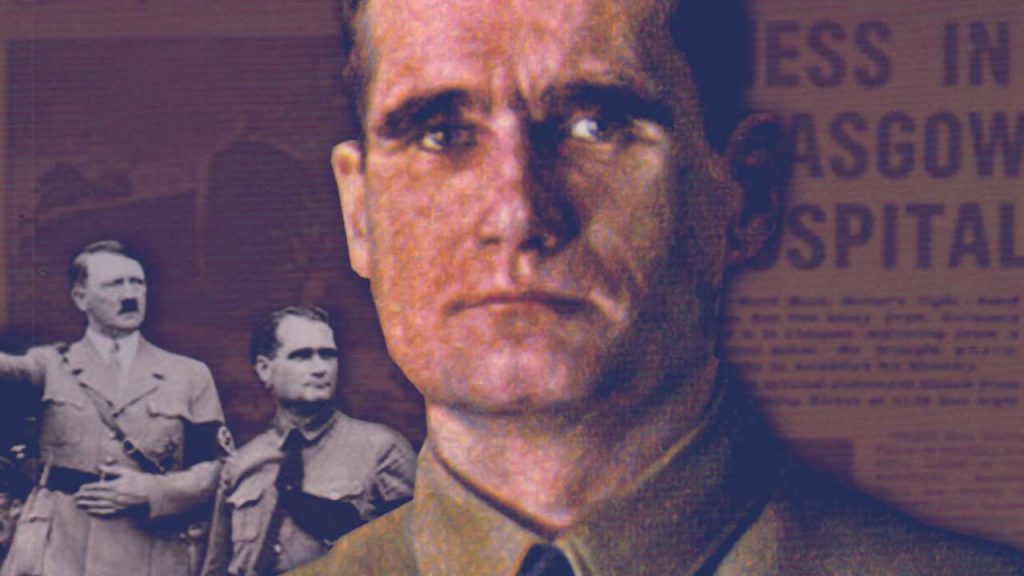
Early Years
Rudolf Hess was born in the English-held city of Alexandria, Egypt, where his education began in 1900 at a German school. Hess left Egypt in 1908 to attend school in Godesberg, Germany. Upon graduation, Hess followed his father’s wishes and joined the family business.[3]
Hess voluntarily joined the First Bavarian Infantry Regiment with the outbreak of World War I. He was wounded in action in December 1916, and was seriously wounded in the lungs the following year. After a period of convalescence, Hess was commissioned with the rank of lieutenant, serving in the ill-fated List Regiment. In 1918 Hess volunteered to join the Imperial Flying Corps, where he flew a few operational flights in November before an armistice ended the war.[4]
Like many Germans, Hess was deeply disappointed by the inglorious way the war ended. The social and political upheaval in postwar Germany greatly affected Hess. He faced a Germany subject to mob-rule, and it seemed that certain regions in Germany might turn communist. During the spring of 1919, Bavaria for a while had a communist state government, and Hess took part in the street fighting which led to its overthrow. Hess was wounded in one leg in this fighting on May 1, 1919.[5]
Hess became convinced there were subversive elements at work in Germany. He read extensively about the situation and concluded that Germany had been brought to its knees by an international conspiracy of Jews and Freemasons.[6] Hess enrolled in the University of Munich, where he was introduced to Karl Haushofer, a major general who was starting a lecture series on geopolitics. Haushofer taught Hess that through an understanding of geopolitics, Germany could overcome its burden of war guilt and emerge again as a great nation. Hess regarded Haushofer as a second father, and Haushofer more or less adopted Hess as his third son.[7]
Hess and Haushofer first met Adolf Hitler one night in 1920 at a beer hall meeting. Hess was transfixed by Hitler’s two-hour speech. Hess joined the National Socialist German Workers’ Party and became convinced that Hitler was the future of Germany. Over the next several months Hess hedged his bets and kept close to both Haushofer and Hitler. However, Hess soon became Hitler’s best friend and one of his most devoted followers.[8]
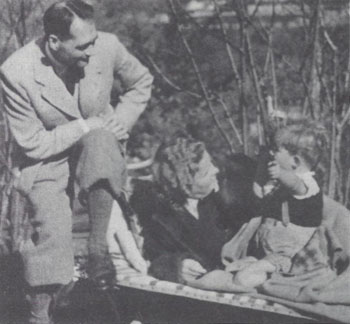
Rise to Power
Hess was convinced Hitler could break the chains of the Versailles Treaty and lead Germany to a better future. Hitler’s first attempt to gain power occurred on November 9, 1923 in his ill-fated attempt to overthrow the government in Munich. Hess arrested three ministers of the Bavarian state government in the course of this unsuccessful putsch. Hitler was punished with imprisonment in the Landsberg Prison for his role in the coup attempt. Hess later joined Hitler in Landsberg Prison.[9]
It was during their time of incarceration that Hitler and Hess established their special relationship of trust and mutual confidence. It was also in Landsberg Prison that Hitler wrote his seminal work, Mein Kampf. Hess edited the pages of this book and checked them for errors. After Hitler was released early from prison on December 20, 1924, Hess became Hitler’s private secretary in April 1925.[10]
Hitler and Hess spent the summer of 1925 proofreading Mein Kampf, and by autumn the first volume was published. Although most readers were bored by this 400-page book, Hitler and Hess immediately set to work on a second volume. Hess remained Hitler’s closest confidant and advisor. Based partly on Hitler’s suggestion, Hess married Ilse Pröhl on December 27, 1927. Hess, Hitler’s private secretary who held no official post, had by 1931 become one of the most powerful and influential members of the National Socialist Party.[11]
Hitler asked Hess to attend all important meetings, introducing Hess in these meetings as one of his “closest colleagues and confidants.” Hess also performed the important function of raising money for the National Socialist Party. Hess succeeded in convincing the industrialist Fritz Thyssen to donate almost a million marks to the party, and also raised money from Otto Kirdorf, the wealthy director of a huge coal syndicate. In short, Hess was involved in numerous aspects of the party’s activities.[12]
Hess even developed what became the customary National-Socialist greeting and departure line: “Heil Hitler.” Also, unlike other close associates of Hitler, Hess never exploited power for himself. Everything Hess did was for Hitler.[13]
Hitler appointed Hess as Deputy Führer of the National Socialist Party on April 21, 1933. Hess’s job was to uphold its national and social principles and lead the governing party as Hitler’s representative. Reich President Hindenburg—acting on Hitler’s proposal—appointed Hess as Reich Minister without Portfolio on December 1, 1933. At the outbreak of war in September 1939, Hess remained Hitler’s close confidant, and a man Hitler trusted without reservation.[14]
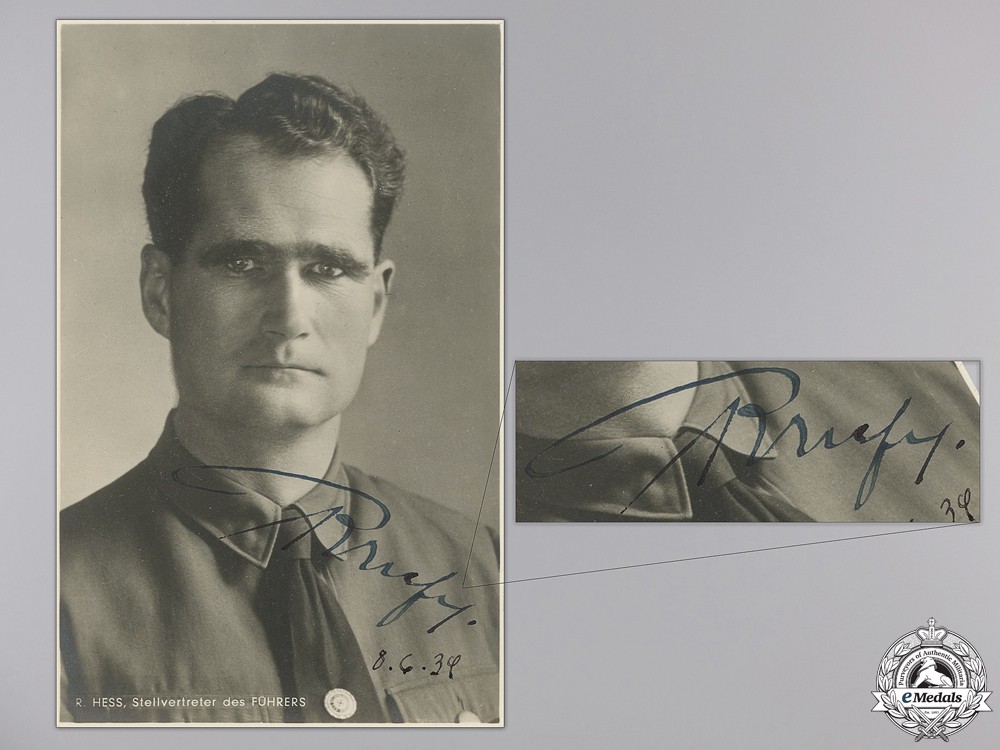
Peace Mission
Hitler had never wanted war with Great Britain. To Hitler, Great Britain was the natural ally of Germany and the nation he admired most. Hitler had no ambitions against Britain or her Empire, and all of the captured records solidly bear this out.[15]
Hitler was eager to make peace once Great Britain and France had declared war against Germany. However, Churchill and other British leaders rejected all of Hitler’s numerous peace offers. Hitler continued to search for a way to end war with Great Britain.
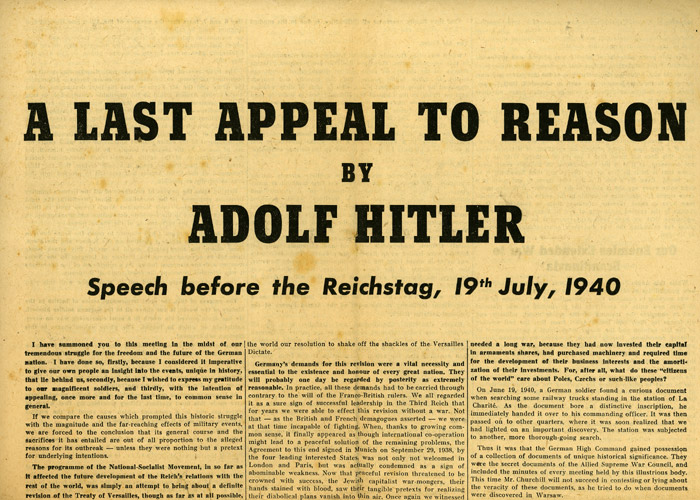
On May 5, 1941, Hitler and Hess met for four hours in the Reichschancellory—alone, without secretaries or aides. After the marathon session, adjutant Alfred Leitgen said the two men emerged appearing particularly affectionate. Leitgen said: “Hitler held Hess’s hand in his for minutes. They silently looked into each other’s eyes.” Leitgen also recalled hearing snippets of the discussions such as the odd phrase “No problems at all with the airplane” and the names “Albrecht Haushofer” and “Hamilton.”[16]
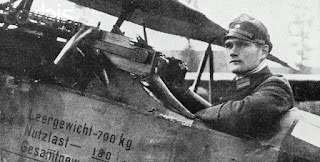
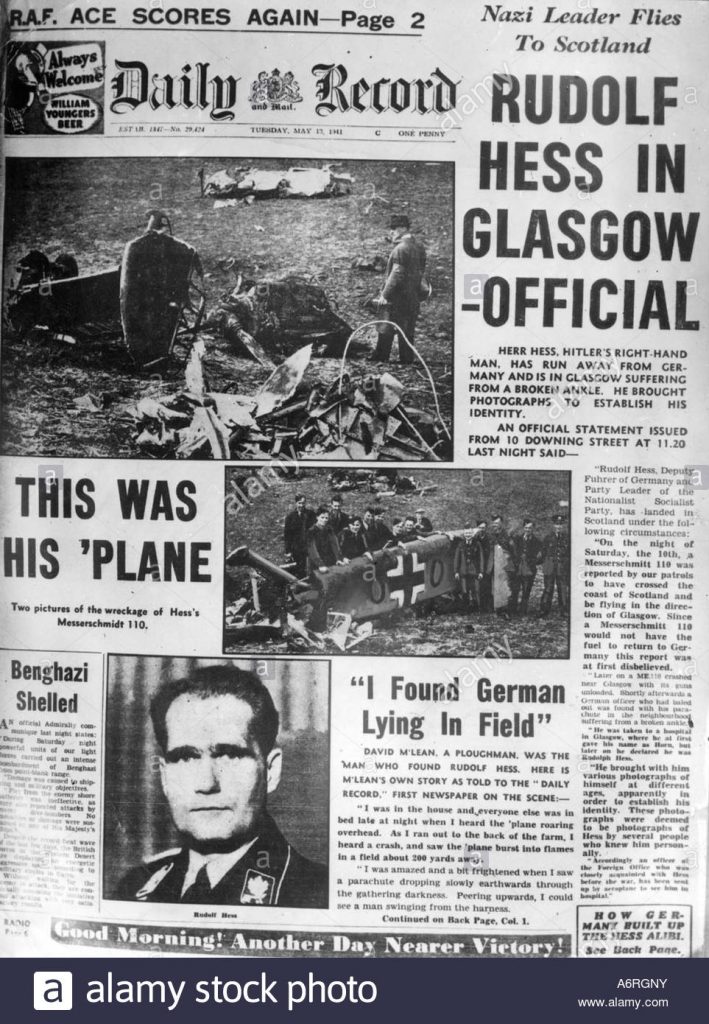
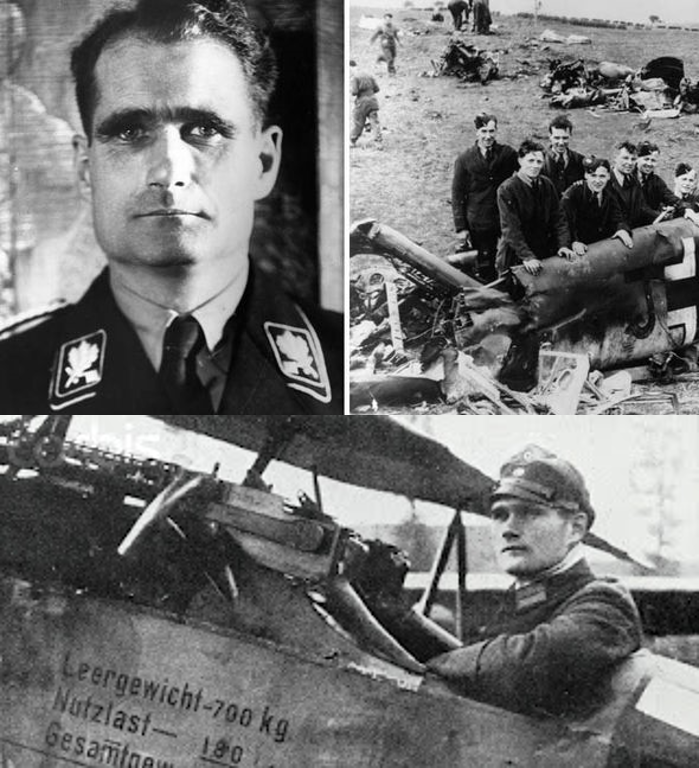
On May 10, 1941, Hess flew an unarmed Messerschmitt 110 to Scotland to attempt to negotiate a peace settlement with Great Britain. Under cover of darkness, Hess successfully evaded British anti-aircraft fire and a pursuing Spitfire. Hess parachuted for the first time in his life, and sprained his ankle landing in a Scottish farm field. A surprised farmer found Hess and turned him over to the local Home Guard unit.[17]
At his request, Hess was taken to speak with the Duke of Hamilton on May 11, 1941. Hess told the Duke of Hamilton why he had flown to Scotland: “I am on a mission of humanity. The Führer does not want to defeat England and wants to stop fighting.”[18] Unfortunately, the British had no interest in negotiating with Hess. On May 16, 1941, Hess was transported late at night in great secrecy to the Tower of London, and spent the rest of the war in British captivity.[19]
Although Hitler and Hess both denied that Hess flew to Scotland with Hitler’s knowledge and approval,[20] the available evidence suggests that Hitler knew and approved of Hess’s mission. The relationship between Hess and Hitler was so close that one can logically assume that Hess would not have undertaken such an important step without first informing Hitler. Also, Hess was prohibited from speaking publicly about his mission during his later 40-year period of imprisonment in Spandau Prison. This “gag order” was obviously imposed because Hess knew things that, if publicly known, would be highly embarrassing to the Allied governments.[21]
German Gen. Franz Halder confirmed after the war that Hess flew to Scotland with Hitler’s knowledge and approval. In an interview at a detention center of the Twelfth Army group at Wiesbaden, Halder told his American interrogators that Hitler dispatched Rudolf Hess to inform the British of Hitler’s peace offer. Halder said,
“The British ‘double-crossed’ Hitler, and informed Moscow of the nature of Hess’s mission.”[22]
Many other people have concluded that Hess flew to Great Britain with Hitler’s full knowledge and approval. For example, Georg Bernhard wrote in The New York Times: “It is now apparent to everybody that Rudolf Hess flew to England with the full consent of Adolf Hitler. It was his job to bring peace between Germany and England.”[23] J. Bernard Hutton wrote, “Hess’s historic flight to Britain was made with Hitler’s full knowledge and approval.”[24] Willis Carto also wrote,
“The evidence is strong that Hess risked his life for peace under orders from Adolf Hitler.”[25]
Nuremberg Trial
The prosecution at the Nuremberg Trial had difficulty building a case against Rudolf Hess. U.S. prosecutor Robert Jackson sent Erich Lipman of the Third U.S. Army to search Ilse Hess’s household for incriminating documents. After trawling through 60 boxes of Hess’s private and official correspondence, Lipman concluded that most of it would only advance Hess’s case, and not that of the prosecution. Lipman declared, “Frankly, I am rather impressed with the type of friends he [Hess] had and the manner in which he frowned upon favoritism, even in the cases of his own family.”[26]
British historian David Irving writes about the difficulty in charging Hess with a crime:
He [Hess] had personally issued a circular telegram to all the gauleiters in November 1938 halting the outrages of the Kristallnacht. He had participated in none of the secret Hitler conferences in 1938 and 1939. As the British well knew, Hess had tried to stop the war and to end the bombing. He had left Germany before the attack on Russia in June 1941 and before the onset of what would in the 1970s become known as the Holocaust. There seemed little real reason to inscribe Hess’s name on any list of war criminals.[27]
Despite the difficulty of charging Hess with a crime, the indictment at the Nuremberg Trial charged Hess with all four criminal counts. Hess regarded the trial as a sham and paid little attention to its proceedings. Although Hess had hardly spoken during the trial, he delivered a memorable closing speech on August 31, 1946. With his speech broadcast around the world, Hess concluded:
“To me was granted to work for many years of my life under the greatest son my country has brought forth in a thousand years of history…The time will come when I shall stand before the judgement seat of the Eternal. I shall answer unto Him, and I know that he will judge me innocent.”[28]
Hess was convicted by the Nuremberg Tribunal on the single count of “crimes against peace” and sentenced to life imprisonment. Soviet Gen. Vasily Sokolovsky, a member of the four-man Allied Control Council in Berlin, attempted to obtain a death sentence for Hess instead of life imprisonment, arguing that Hess was “responsible for all the crimes committed by the Nazi regime.” The other Control Council members rejected Sokolovsky’s request.[29]
British historian A. J. P. Taylor wrote concerning the injustice of the Hess case:
Hess came to this country in 1941 as an ambassador of peace. He came with the…intention of restoring peace between Great Britain and Germany. He acted in good faith. He fell into our hands and was quite unjustly treated as a prisoner of war. After the war, we could have released him.
No crime has ever been proven against Hess…As far as the records show, he was never at even one of the secret discussions at which Hitler explained his war plans. He was of course a leading member of the Nazi Party. But he was no more guilty than any other Nazi or, if you wish, any other German. All the Nazis, all the Germans, were carrying on the war. But they were not all condemned because of this.[30]
It is ironic that Hess – the only defendant at Nuremberg who had risked his life for peace – was found guilty of “crimes against peace.” The life sentence given Hess by the judges at Nuremberg was an extreme perversion of justice.
Imprisonment
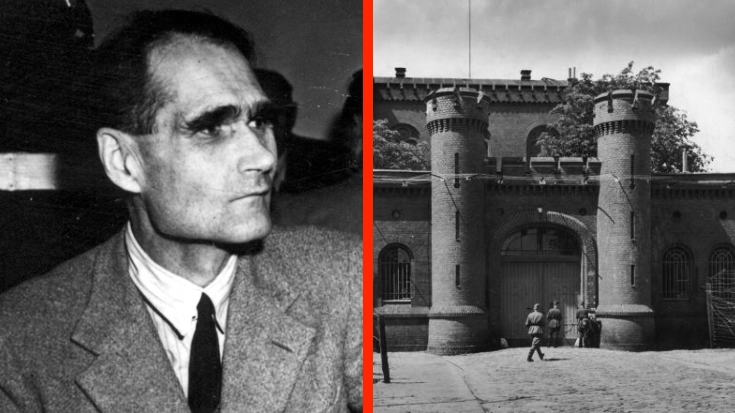
Rudolf Hess was imprisoned in West Berlin’s Spandau Prison in 1947. Regulations forbade prison officials from calling Hess by his name; he was addressed only as “Prisoner No. 7.” For the first 20 years of his imprisonment, Hess at least had the limited company of a few other Nuremberg defendants. However, with the release of Albert Speer and Baldur von Schirach in October 1966, Hess was the only prisoner in Spandau until his death 21 years later.[31]
After Hess became the only prisoner in Spandau, he told U.S. Lt. Col. Eugene Bird: “I am an innocent man. I see no reason why I should not be turned loose. Even if I were guilty—which I am not—no other prisoner who has been sentenced to life or even death for their war crimes still remains in jail. I am the only one I know of who has not been freed. It is all wrong.” However, the Russians would not consider freeing Hess.[32]
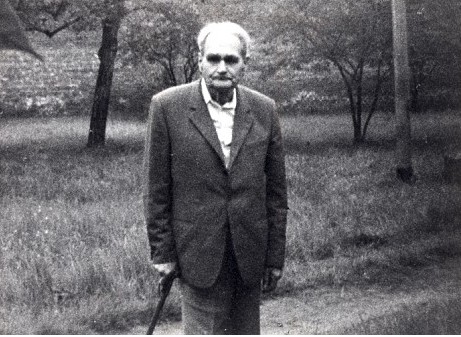
Hess’s Cell Number 7 in Spandau became the world’s most expensive single-bed accommodation. Including full board, the daily cost of this two by three-meter room was 2,800 deutsche marks. Hess was watched around the clock by three armed guards, 20 prison officials, 17 civilians, four doctors, one chaplain and four prison directors. Thus, the loneliest prisoner in the world sat behind bars, walls and barbed wire for an entire generation—costing the taxpayers of West Berlin and West Germany millions of deutsche marks.[33]
Hess died in Spandau Prison on August 17, 1987, allegedly by hanging himself in a summerhouse in the prison garden. Hess’s death was ruled a suicide. However, the idea that Hess committed suicide quickly unraveled. Dr. Hugh Thomas, a British military medic, wrote that the arthritic hands of Hess were far too weak for a suicide attempt. It would have been impossible for Hess to lift his hands above his head, let alone hang himself or tighten a noose. Dr. Thomas concluded that Hess had been strangled from behind with an electric cord.[34]
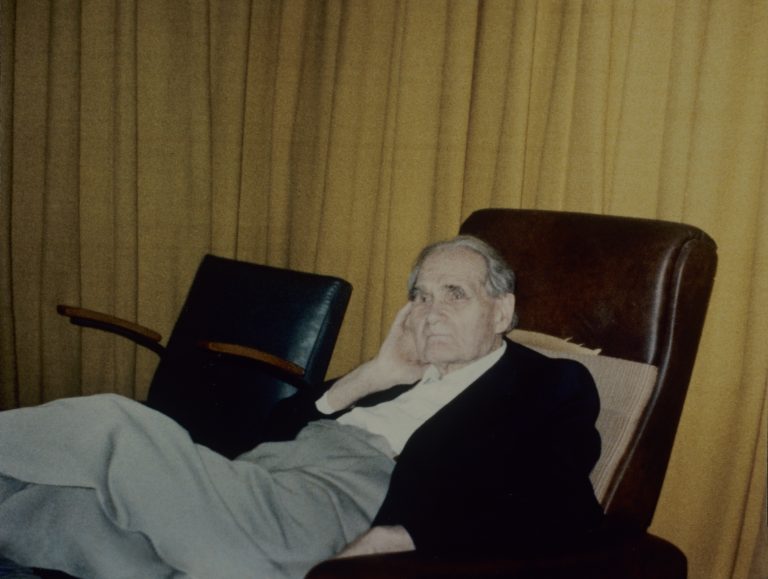

Abdallah Melaouhi, a medical aide at Spandau who became close friends with Hess, writes that on the day Hess died, Malaouhi was held up for 20 minutes at a locked door before he could see Hess. When he finally arrived on the scene, Melaouhi was convinced a struggle had taken place. All of the furniture had been overturned, and even the straw mat was out of place. The extension cord that Hess allegedly used to hang himself was plugged into the socket in the wall and still connected to the lamp. When Melaouhi arrived at the scene, American guard Anthony Jordan said to him,
“The pig is finished!”[35]
Melaouhi writes that he is convinced he could have saved Hess’s life if he had been promptly admitted through the main gate and allowed to take a straight route to the garden house. Melaouhi also states that the course of events that led to Hess’s alleged self-strangulation were impossible both technically and physically. He concludes that Hess did not commit suicide, but was instead murdered by British and American agents.[36]
An alleged suicide note written by Hess was discovered by the Allies two days after Hess’s death. This suicide note was later proven to be a crude hoax. Hess’s son Wolfgang concluded:
“Rudolf Hess did not commit suicide on August 17, 1987, as the British government claims. The weight of evidence shows instead that British officials, acting on high-level orders, murdered my father.” [37]
Conclusion
Winston Churchill wrote about Rudolf Hess after the war:
Reflecting upon the whole of this story, I am glad not to be responsible for the way in which Hess has been and is being treated. Whatever may be the moral guilt of a German who stood near to Hitler, Hess had, in my view, atoned for this by his completely devoted and fanatic deed of lunatic benevolence. He came to us of his own free will and, though without authority, had something of the quality of an envoy. He was a medical and not a criminal case, and should be so regarded.[38]
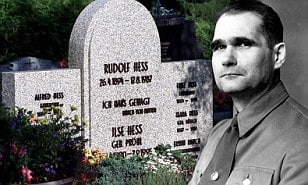
Churchill was being disingenuous when he said he was not responsible “for the way in which Hess has been and is being treated.” Not only did Churchill refuse to negotiate with Hess, but Churchill kept Hess incarcerated in Great Britain until the end of the war. Churchill also never used his considerable influence to attempt to keep Hess from being sent to the Nuremberg Trial.
Hess continues to be disrespected and subject to injustice after his death. Hess was not even allowed to stay buried in his chosen town of Wunsiedel. The town of Wunsiedel became the scene of pilgrimages for people who wanted to honor Hess for his courageous effort to negotiate peace with Great Britain. On July 20, 2011, Hess’s grave was reopened and his remains were exhumed and then cremated. His ashes were scattered at sea, and his gravestone, which bore the epitaph “I took the risk” was destroyed.[39]
Historian Mark Weber writes:
“The injustice against Hess was not something that happened once and was quickly over. It was, rather, a wrong that went on, day after day, for 46 years. Rudolf Hess was a prisoner of peace and a victim of a vindictive age.”[40]
Endnotes
[1] Douglas-Hamilton, James, Motive for a Mission: The Story Behind Hess’s Flight to Britain, London: MacMillan St. Martin’s Press, 1971, p. 51.
[2] Schwarzwäller, Wulf, Rudolf Hess: The Last Nazi: Bethesda, Md.: National Press, Inc., 1988, p. 121.
[3] Manvell, Roger and Fraenkl, Heinrich, Hess: A Biography, New York: Drake Publishers Inc., 1973, pp. 17-19.
[4] Ibid., p. 19.
[5] Ibid., pp. 19-20.
[6] Schwarzwäller, Wulf, Rudolf Hess: The Last Nazi, Bethesda, Md.: National Press, Inc., 1988, p. 15.
[7] Kilzer, Louis C., Churchill’s Deception: The Dark Secret that Destroyed Nazi Germany, New York: Simon & Schuster, 1994, pp. 83-84.
[8] Ibid., pp. 93-94.
[9] Hess, Wolfgang, “The Life and Death of My Father, Rudolf Hess,” The Journal of Historical Review, Vol. 13, No. 1, Jan./Feb. 1993, p. 27.
[10] Ibid.
[11] Schwarzwäller, Wulf, Rudolf Hess: The Last Nazi, Bethesda, Md.: National Press, Inc., 1988, pp. 115-119.
[12] Ibid., pp. 118-119.
[13] Kilzer, Louis C., Churchill’s Deception: The Dark Secret that Destroyed Nazi Germany, New York: Simon & Schuster, 1994, pp. 108-109.
[14] Hess, Wolfgang, “The Life and Death of My Father, Rudolf Hess,” The Journal of Historical Review, Vol. 13, No. 1, Jan./Feb. 1993, p. 28.
[15] Irving, David, Hitler’s War, New York: Avon Books, 1990, p. 3.
[16] Kilzer, Louis C., Churchill’s Deception: The Dark Secret that Destroyed Nazi Germany: New York: Simon & Schuster, 1994, p. 275.
[17] Weber, Mark, “The Legacy of Rudolf Hess,” The Journal of Historical Review, Vol. 13, No. 1, Jan./Feb. 1993, p. 20.
[18] Langer, Howard J., World War II: An Encyclopedia of Quotations, Westport, Conn.: Greenwood Press, 1999, p. 142.
[19] Douglas-Hamilton, James, Motive for a Mission: The Story Behind Hess’s Flight to Britain, London: MacMillan St. Martin’s Press, 1971, pp. 175, 182-189.
[20] Bird, Eugene K., Prisoner #7: Rudolf Hess, New York: The Viking Press, 1974, p. 202.
[21] Hess, Wolf Rüdiger, “The Life and Death of My Father, Rudolf Hess,” The Journal of Historical Review, Vol. 13, No. 1, Jan./Feb. 1993, pp. 29, 31.
[22] Kilzer, Louis C., Churchill’s Deception: The Dark Secret that Destroyed Nazi Germany, New York: Simon & Schuster, 1994, pp. 72-75.
[23] Ibid., p. 55.
[24] Hutton, J. Bernard, Hess: The Man and His Mission, New York: The MacMillan Company, p. 21.
[25] Melaouhi, Abdallah, Rudolf Hess: His Betrayal and Murder, Washington, D.C.: The Barnes Review, 2013, p. 7.
[26] Irving, David, Nuremberg: The Last Battle, London: Focal Point Publications, 1996, p. 148.
[27] Ibid., p. 29.
[28] Ibid., pp. 144, 255.
[29] Ibid., pp. 280, 284-285.
[30] Sunday Express, London, April 27, 1969.
[31] Weber, Mark, “The Legacy of Rudolf Hess,” The Journal of Historical Review, Vol. 13, No. 1, Jan./Feb. 1993, pp. 22-23.
[32] Bird, Eugene K., Prisoner #7: Rudolf Hess, New York: The Viking Press, 1974, p. 152.
[33] Schwarzwäller, Wulf, Rudolf Hess: The Last Nazi, Bethesda, Md.: National Press, Inc., 1988, pp. 13-14.
[34] Melaouhi, Abdallah, Rudolf Hess: His Betrayal and Murder, Washington, D.C.: The Barnes Review, 2013, pp. 152-154.
[35] Ibid., pp. 120, 128-129.
[36] Ibid., pp. 35, 130-131, 135.
[37] Hess, Wolfgang, “The Life and Death of My Father, Rudolf Hess,” The Journal of Historical Review, Vol. 13, No. 1, Jan./Feb. 1993, pp. 38-39.
[38] Churchill, Winston S., The Grand Alliance, Boston: Houghton Mifflin, 1950, p. 55
[39] BBC News Europe, July 21, 2011.
[40] Weber, Mark, “The Legacy of Rudolf Hess,” The Journal of Historical Review, Vol. 13, No. 1, Jan./Feb. 1993, p. 23.

13 Responses
When I read fine articles such as this with regards to the brilliant persons in leadership positions in National Socialist Germany I am reminded once again how much heads and shoulders these individuals were way above and beyond the pathetic excuses we have of leadership roll models running our world today, particularly here within the United States (where everyone grovels before the feet of their jewish overlords). Here were persons of passion, grace and expansive intelligence that at times seem more out of sublime ancient mythology then the world we live in today. Rudolf Hess was most certainly one of these exceptionally fine, well-educated and gifted individuals, and his horrendous mistreatment by the allies both during and after the war is a most shameful stain upon the United States, Britain and Russia. More so, the unbelievable torture – physically, mentally, emotionally and spiritually – he most certainly was forced to endure through those many decades of cruel imprisonment and constant isolation I can only hope God has reserved for him a very special and most honorably deserved place in heaven. May he rest in peace and ultimately be remembered for the truly great man that he was. God bless Rudolf Hess. And God bless the great Reich leadership. They all deserve our profound awe, respect and admiration. The day will come when they will be honored with great, inspiring monuments that will last long and enduring through the ages. And what of our leadership responsible for this original shame (and the shame that continues to endure via their successors)? They will be consigned to eternal disgrace, serving as morbid examples to all good and honorable men and women what we must avoid with regards to the dark, sadistic and exploitive side of human nature. I, for one, long for the day when I can piss on the graves of Roosevelt, Churchill and Stalin, amongst many numerous others.
I completely agree!!
This is just more typical behavior by what Saul of Tarus warned his henchman Titus to beware from “he of the circumcision group”.
If you don’t fit their “idle talk” narrative and their ability to say that which should not be allowed-to-be said then the appropriate lies will be told in order to fit your square-peg into the round hole they’ve drilled for you.
When one-such individual attempted to so-fit me and I answered “I’m sorry but you’ve mistaken me for someone who does extortion for-profit” the response was ( and I’ll never forget it ) “we didn’t think you’d be that smart”.
Imagine the total arrogance to freely admit that in a phone call which might be being recorded! They simply do not care because they know they have all loose-ends tied-up to the extent they don’t need to worry.
The Long March of Lies through the Institutions of Western Civilization is about to arrive at it’s desired destination. The finish-line is in view and the marchers are sprinting for it.
The dominionist/Huckabites who have paved it’s path with their good intentions know who they are. They refuse to part with their fantasies and the empty promises which have motivated them.
They have judged their tormentors by a law they follow. They believe that a statement was made that not one jot or tittle of that law would change “until all is done” without ever once bothering to stop and think that, implicit in this statement is that once “all is done” then every jot and every tittle of that law is subject to change and when it does, that’s when they will recognize those who lived by that former law are of a totally different nature than they had thought possible.
When the various affable deathstalker claw-puppets are shed from those cruel claws upon which they have performed the quadrennial Punch and Judy show for the bemusement of the “mushroom” electorate only then will the horrible reality settle over it in a pall of abject terror. There will be scant chance of escaping the corner into which they have painted themselves and even less inclination to even try.
I predict Laura’s Theme to become a very popular request on various media sources.
There will be no United States to serve as a ready support to insurgents against this “jubilee”.
Saul Alninsky said “when they have the guns will will rule by the ballot”. That occurred November 3rd, 2020. the “Paul Harvey” rest-of-the-story on that Alinsky quote is “when we have the guns we will rule by the bullet”. Failing a successful attempt on November 3rd 2022 of the dominionist/Huckabite pseudo-conservatives to recapture at least simple majorities in the two houses of the Legislature the meaning of that “Paul Harvey” will soon become apparent. Chairman Mao said it most succinctly. “All power pours from the barrel of a gun”. So the way in-which all power can be concentrated into few hands and the majority can be converted from citizens to subjects is by such a concentration.
The best litmus-test for a free citizenry to consider ever invented was that anyone who asks you to trust him with the exercise of your franchise but who will not trust you with the possession of whatever constitutes a Main Battle Rifle of contemporary design is unworthy of your trust. It was the first principle upon-which the First Confederacy had to get settled before it would proceed to other Constitutional Amendments before signing-on to a Constitutionally-lmited singular Republican authority in-which would be vested the power to raise armies, stamp coins and denominate specie. Later the dominionists exerted their baleful influence and subsumed 1st billing in the Bill of rights for their favorite fairy-tale under the guise of “freedom of expression” but earlier copies of this document will find that the true First Freedom was that of being free from any doubt about who can and cannot be entrusted with the levers of power. A simple litmus test which could be understood by anyone from the most erudite Man of Letters to any rustic rube.
But the prediction that those who would surrender liberty for a promise of security would find themselves enjoying neither has come to pass. 300 tyrants one mile away have spoken and proved that they are in no-way superior to one unjust tyrant 3,000 miles away. Those who have obdurately refused to remember the intervening history between then and now in many societies all over the earth are now condamned to repeat it.
And the living will envy the dead.
You are correct. We are watching all the Marxist dreams come true all over the world. Hitler tried to prevent it, everyone ganged up on him to end the thought of any sirt of freedom. No one seems to realize they are just the puppets of the Zionist Central Banks who will do away with them once their takeover is complete. (sirt s/b sort, will not let me correct.)
Die Geschichte ist immer noch unvollständig erzählt. Hess hat noch viel mehr erlitten durch die Bosheit von Churchill und den Briten. Vor dem Militärtribunal in Nürnberg sprach Hess von Sowjetischen Schauprozessen und seiner Beobachtung, daß anderen vor seinen Augen in britischer Gefangenschaft (wohl auch ihm selbst) Drogen verabreicht wurden, die die Augen glasig machten und das Wesen der Betroffenen änderten. Wollte Hess zwischen den Zeilen aussagen, daß er Nürnberg für einen Schauprozeß hielt? Immerhin gibt es bis heute Drogen- und Folterprogramme der Alliierten. Auch der Reichsführer SS Himmler verhandelte heimlich mit den Briten über einen Friedensschluß und wurde nach Kriegsende gefoltert und ermordet, von Briten. Der Mord an Hess erfolgte unter Billigung der Amerikaner, unter Mitwirkung von Bundespräsident Weizsäcker und nach Beauftragung durch den britischen Innenminister unter Margret Thatcher durch den SAS. Der russische Präsident Gorbatschow hatte eine Entlassung von Hess ins Auge gefaßt. Der gefährliche Zeuge mußte beseitigt werden. Heß war vom Britischen Geheimdienst unter Churchills Anleitung in eine Falle gelockt worden. Sie hatten Friedensverhandlungen geheuchelt, um Hitler zu schaden und heß zu ermorden. Heß war in einer unmenschlichen Anstrengung von Augsburg nach Schottland geflogen, nachdem für ihn ein Flugzeug technisch umgerüstet und mit größeren Tanks versehen wurden, die 700 Liter Flugbenzin faßten. Daß er nicht beschossen wurde, lag an Befehlen Churchills. Die Landebahn wurde mit Absicht von der Beleuchtung gelöscht, so daß das Flugzeug von Heß zerschellte. Das war ein Mordattentat von Churchill. Mit dem Fallschirm konnte Hess sich retten. Er hatte die Flugroute auswendig gelernt, Blindflug geübt, 30 Probeflüge durchgeführt. Das Internationale Recht sieht Hess als Parlamentär an. Die Gefangensetzung war ebenso illegal wie die Bombardierung deutscher Städte. Haushofer und seine Frau, die Zeugen der Vorbereitung des Fluges von Hess waren, wurden von den Briten ermordet und Beweismaterial vernichtet.
Deepl Translation of Hilken’s comment:
The story has still not been fully told. Hess suffered much more at the hands of Churchill and the British. Before the military tribunal in Nuremberg, Hess spoke of Soviet show trials and his observation that others in British captivity (and likely himself as well) were administered drugs right before his eyes that made their eyes glassy and altered their very being. Was Hess implying between the lines that he considered Nuremberg a show trial? After all, Allied drug and torture programs continue to this day. Reichsführer-SS Himmler also secretly negotiated a peace settlement with the British and was tortured and murdered by the British after the war ended. Hess’s murder took place with American approval, with the cooperation of Federal President Weizsäcker, and was carried out by the SAS on the orders of the British Home Secretary under Margaret Thatcher. Russian President Gorbachev had considered releasing Hess. The dangerous witness had to be eliminated. Hess had been lured into a trap by British intelligence under Churchill’s direction. They had feigned peace negotiations in order to harm Hitler and assassinate Hess. Hess had flown from Augsburg to Scotland in an inhuman feat of endurance after an aircraft had been technically modified for him and fitted with larger fuel tanks holding 700 liters of aviation fuel. The fact that he was not shot down was due to orders from Churchill. The runway lights were deliberately turned off so that Hess’s plane would crash. This was an assassination attempt by Churchill. Hess was able to save himself by parachute. He had memorized the flight route, practiced flying blind, and conducted 30 test flights. International law considers Hess a parliamentary envoy. His imprisonment was just as illegal as the bombing of German cities. Haushofer and his wife, who had witnessed the preparations for Hess’s flight, were murdered by the British, and evidence was destroyed.
Once again, I want to express gratitude to Hilken for your comments on our website, with all the additional information you are enlightening us with. Thank you!
Liebe Monika, danke für die vielen freundlichen Worte, auch an anderer Stelle! Ich stecke seit zwei Jahren tief im Thema, weil ich die Kriegsbiografie meiner Großeltern verfasse. Dazu mußte ich endlos Videos sichten und Bücher lesen. Viel von meinem Wissen konnte ich aber in die Biografie nicht einfließen lassen. Daher schreibe ich hier sehr gerne, in dem Wissen, daß andere sich dafür interessieren könnten. außerdem entwickele ich eine Art 7. Sinn, der mich schon viel hat entdecken lassen. Ich finde es auch gut, aus deutscher Sichtweise Bemerkungen machen zu können. Vielen Dank für den Raum, den ich mir hier nehmen darf. Susanne
Je mehr man auf dem Knochen kaut, desto mehr Saft kommt heraus. Peter Fleming, The Flying Visit, 1940, hatte ein Jahr vor dem Flug von Heß einen Roman herausgegeben, in dem Hitler mit dem Fallschirm über England abspringt mit einem Friedensgesuch.
Ich sehe dies als ein Indiz für einen länger ausgeheckten und spruchreifen Plan im Bereich des britischen Geheimdienstes, den Fleming kannte. Übrigens ist die MI6-Akte noch immer gesperrt, was die bösesten Spekulationen über die britische Regierung nährt. Churchill hat neben dem britischen Geheimdienst Heß direkt befragt. Man kann davon ausgehen, daß es einen fertigen deutschen Friedensplan gab mit dem Angebot, alle besetzten europäischen Länder freizugeben, den Churchill sabotierte. Wie ich Hitler einschätze, wird er alle Folgen für Europa in diesem Plan ausgearbeitet haben, einschließlich des Krieges mit der Sowjetunion. Bei Freigabe der Akte würde also herauskommen, daß Churchill wollte, daß die Sowjetunion von Hitler zu Krieg gezwungen werde und er nicht wollte, daß das generöse Friedensangebot Hitlers bekannt werde, weil die Öffentlichkeit ihm dann jedwede Unterstützung seiner Kriegstreiberei entzogen hätte.
translation:
The more you chew on the bone, the more juice comes out. Peter Fleming, in *The Flying Visit* (1940), had published a novel a year before Hess’s flight in which Hitler parachutes into England with a plea for peace.
I see this as evidence of a plan that had been hatched some time ago and was ready to be put into action within the British secret service, with which Fleming was familiar. Incidentally, the MI6 file is still classified, which fuels the most malicious speculation about the British government. In addition to consulting the British secret service, Churchill questioned Hess directly. It is reasonable to assume that there was a fully-fledged German peace plan on the table, offering to liberate all occupied European countries, which Churchill sabotaged. As I understand Hitler, he would have worked out all the consequences for Europe in this plan, including the war with the Soviet Union. If the file were to be released, it would therefore emerge that Churchill wanted the Soviet Union to be forced into war by Hitler and that he did not want Hitler’s generous peace offer to become public knowledge, because the public would then have withdrawn all support for his warmongering.
Dear Susanne, that is wonderful that you are doing a biography of your grandparents, which has led you to doing all this research. We appreciate your comments here very much. At our next TJGS meeting, I will draw attention to the wonderful work you have been doing. Perhaps at some point I will even publish an article which takes some samples of your comments, and this way also draw attention to your commentaries.
There will be a gap for a few days in my ability to do the translations, as I have exceeded my limit on the free version of Deepl. I might solicit some help with that, as it is well worth it.
Aus dem Fall Heß wird deutlich, daß der britische Premierminister Churchill den europäischen Krieg zu einem Weltkrieg ausweitete. Das geschah in Deckung von Roosevelt und seinen Beratern wie Bernard Baruch. Hinter Churchill standen mehrere Geheimgesellschaften um Cecil Rhodes und Alfred Milner, aber auch die den bankrotten Churchill finanzierende Focus-Gruppe.
translation: The Hess affair makes it clear that the British Prime Minister, Churchill, escalated the European war into a world war. This took place with the backing of Roosevelt and his advisers, such as Bernard Baruch. Behind Churchill stood several secret societies centred on Cecil Rhodes and Alfred Milner, as well as the Focus Group, which was financing the bankrupt Churchill.
Die erste Obduktion an Rudolf Heß führte am 18.08.1987 der britische Gerichtsmediziner James Cameron im britischen Militärhospital in Berlin durch. Die Todesursache wurde als Suizid durch Erhängen bestimmt. Am 20.08.1987 veranlaßte die Familie Heß eine zweite Obduktion, die von dem angesehenen Münchner Gerichtsmediziner Prof. Dr. Wolfgang Spann am Institut für Rechtsmedizin der Ludwig-Maximilians-Universität durchgeführt wurde. Die Frage nach der Vorgeschichte wurde mit “Kein Kommentar” beantwortet. Nur wurde mitgeteilt, daß ein Stromkabel eine Rolle spielte. Die atypische horizontale Strangulationsfurche wies auf eine Erdrosselung oder Erwürgen hin, nicht auf Suizid. Prof. Dr. Wolfgang Spanns Autobiografie „Kalte Chirurgie: Ein Leben zwischen Medizin und Recht“ erschien 1995. In ihm enthalten ist die Kasuistik von Rudolf Heß. Die inneren Organe Kehlkopf, Luftröhre, Schilddrüse und Halsschlagader wurden während der Autopsie durch Cameron zerstört. Damit war es nicht mehr möglich, zwischen einem Tod durch Erdrosseln (Fremdeinwirkung) und Erhängen sicher zu unterscheiden. Das machte eine Nachuntersuchung unmöglich. Ein glattes Kabel sei mit einer Selbsterhängung nicht vereinbar. “Nach allem, was was die Familie und ich als sein Verteidiger bis jetzt in Erfahrung bringen konnten, wurde Rudolf Heß in den Nachmittagsstunden des 17. August 1987 im Alliierten Militärgefängnis in Berlin-Spandau ermordet. Berlin, im August 1988. Dr. Alfred Seidl” Der letzte Pfleger bis zum Tode von Rudolf Heß Abdallah Melaouhi veröffentlichte 2022 das Buch „Ich sah seinen Mördern in die Augen“. Der streng geheime schon seit Jahren vorbereitete Notfall-Plan PARADOX der britischen Militärverwaltung wurde im Jahr vor dem Tode von Heß veröffentlicht und sah die sofortige Zerstörung von Spandau nach der Obduktion und Freigabe der Leiche vor. Die Autoren des Plans befanden sich im britischen Außenministerium, Premier war (seit 1979) Thatcher – werden bis heute verheimlicht.
Nach 24 Stunden wurde das Gartenhaus, Fundort der Leiche abgetragen. Eine Woche nach dem 17.08.1987 erfolgte der Abriß des Gefängnisses Spandau durch britische Soldaten. Filmaufnahmen waren unter bewaffneten Wachen streng verboten, wurden unter Lebensgefahr aber angefertigt. Die Entscheidung auch zum Zerkleinern und Verstreuen des Bauschutts in der Nordsee bzw. Vergraben auf dem RAF-Stützpunkt Gatow trafen die vier Alliierten Mächte. Die Kosten für den Abbruch des Kriegsverbrechergefängnisses Spandau im Jahr 1987 wurden vom West-Berliner Senat getragen. Schon ab 1970 beliefen sich die Gesamtkosten auf 600.000 DM jährlich und die Kosten des Wachpersonals für vier Alliierte Mächte, getragen vom Berliner Steuerzahler. Die Alliierten ließen sich es mit vielen Empfängen gut gehen, während der Häftling schlecht versorgt war. Kein Deutscher wurde je befragt, ob er das Spandauer Gefängnis zur Gedenkstätte umzuwandeln und zu erhalten wünsche.
Translation of Hilken’s comment:
The first post-mortem examination of Rudolf Hess was carried out on 18 August 1987 by the British forensic pathologist James Cameron at the British military hospital in Berlin. The cause of death was determined to be suicide by hanging. On 20 August 1987, the Hess family arranged for a second post-mortem examination, which was carried out by the renowned Munich forensic pathologist Prof. Dr Wolfgang Spann at the Institute of Forensic Medicine at Ludwig Maximilian University. The question regarding his medical history was answered with “No comment”. It was merely stated that an electric cable played a role. The atypical horizontal strangulation mark indicated strangulation or suffocation, not suicide. Prof. Dr Wolfgang Spann’s autobiography *Cold Surgery: A Life between Medicine and Law* was published in 1995. It includes the case study of Rudolf Hess. The internal organs – the larynx, trachea, thyroid gland and carotid artery – were destroyed by Cameron during the post-mortem examination. This meant it was no longer possible to distinguish with certainty between death by strangulation (external cause) and hanging. This made a follow-up investigation impossible. A smooth cable is incompatible with suicide by hanging. “According to everything that the family and I, as his defence counsel, have been able to ascertain so far, Rudolf Hess was murdered in the afternoon of 17 August 1987 at the Allied military prison in Berlin-Spandau. Berlin, August 1988. Dr Alfred Seidl” Abdallah Melaouhi, the last nurse to care for Rudolf Hess until his death, published the book *I Looked His Murderers in the Eye* in 2022. The top-secret emergency plan PARADOX, which had been in preparation for years by the British military administration, was published in the year prior to Hess’s death and provided for the immediate destruction of Spandau following the post-mortem examination and the release of the body. The authors of the plan were based in the British Foreign Office; the Prime Minister at the time (since 1979) was Thatcher – their identities remain concealed to this day.
After 24 hours, the garden shed where the body had been found was demolished. One week after 17 August 1987, Spandau Prison was demolished by British soldiers. Filming was strictly prohibited under armed guard, but was carried out at the risk of one’s life. The decision to crush and scatter the rubble in the North Sea or to bury it at the RAF base in Gatow was taken by the four Allied Powers. The costs of demolishing Spandau Prison, the war crimes prison, in 1987 were borne by the West Berlin Senate. As early as 1970, the total annual costs amounted to 600,000 DM, and the costs of the guard personnel for the four Allied Powers were borne by Berlin taxpayers. The Allies enjoyed themselves at numerous receptions, whilst the prisoner was poorly looked after. No German was ever asked whether they wished to see Spandau Prison converted into a memorial and preserved.