In the Afterword of my previous article entitled: “Master Architect, Artist, Statesman, Renaissance Man, Highly Decorated Army Veteran & Leader of his People” I made mention of my one late uncle’s experiences in Europe during and immediately after World War II. His private revelations to me greatly influenced my own understanding of that calamitous episode in the life of my own country (USA), Europe and Germany. Furthermore, it affected my outlook on 2,000 years of history. I would like to share in greater detail what my late uncle shared with me, and how I prodded it out of him, against a backdrop of admonishments from relatives who insisted I drop the subject. What follows is essentially how I went about this, and how it turned out to be an eye-opening treasure-trove of information. I could have gone into more detail here, but I believe this essay conveys the essence of what he shared with me. I hope to eventually write a more detailed explanation of events based on my notes, and put it into a modest book.
It was approximately seven months after my one aunt’s untimely death in 1979, and my uncle was living alone at that time in the lovely house and gardens he had built for my aunt and their children following the war. I would periodically visit him for a couple of hours to see how he was doing. I confess it was somewhat difficult and emotionally draining to visit him at the home I had only always known him to have shared with my aunt and my two cousins. It was always a strange feeling not finding my aunt there to greet me. In addition, the fact that the house interiors appeared somewhat dark, neglected, and not that well maintained to former standards was also somewhat disconcerting. That void seemed so very overwhelming to me.
One particularly longer-than-usual, (and unexpected) nearly five-hour long visit, my uncle and I once again found ourselves sitting at the kitchen table – he smoking his cigarettes and sipping a “long-neck” bottle of beer. After retrieving one for me we sat there “shooting the breeze”, just talking about lighthearted things that simply kept the conversation flowing. For the first hour or so I inquired how he was doing and what projects he was working on. Sharing my own personal and professional endeavours also provoked his interests. Yet, there was an obvious cloud that hung over the setting, as I knew most assuredly he missed my late aunt most deeply.
I honestly don’t remember exactly how the subject of his war experiences came up. I believe it was the result of my asking how and when he met my aunt in the late nineteen thirties, their dating, going dancing at various ballrooms throughout the area featuring the likes of Tommy Dorsey and Glenn Miller. They both loved to dance, and back then it was a given that any young boy and girl who did not know how to dance by the time they were dating during their teenage years was most assuredly thought of as a pariah of sorts. Compare that to the world we live in today. I can still recall watching my aunt and uncle perform quite a “swing” on any dance floor at various family and social gatherings. My own family in-house duo of a Ginger Rogers and a Fred Astaire.
His personal observations about events leading up to the war in Europe, and the later time when he enlisted in the US army when it entered the conflict, began to flow with a little more ease since it was just the two of us. He knew for some years that I had a most unusual and somewhat aggressive interest in history compared to others in the family. One thing seemed to evolve into another as he, at first vaguely, began to describe his experiences in Europe, but then eventually going into much more detail. I still vividly recall his eyes looking past me (or right thru me) as he sat there sipping his beer and smoking away. The more he spoke, the more deeply he inhaled. I began to gently inquire about a detail here or there, subtly asking him to enlighten me further, all the while trying to maintain a “lightness” and a not-too-invasive approach. I did not want to abuse this privilege. Yet, I sensed he knew I was sincere in my interest wanting to simply know the truth.
Finally, there was a moment, and I’m not quite sure how I approached it, that I asked him to go into further detail about his experiences once he had crossed the Rhine River into Germany proper. Tears would appear as he mentioned gently at first, that the ground fighting had grown more violent, losing comrades, who had become close, intimate buddies. One moment they were there talking in hushed tones or whispering – the next moment one would be lying dead next to him, blood everywhere (including on himself) with his late comrade’s eyes laying there wide open. One moment a living, sentient human being – the next moment a lifeless corpse. These earlier memories were mostly of the conflict between his “outfit” and the Germans on the other side. He rarely saw them beyond a certain distance and was just shooting back and forth. Early on he did not see them so much as fellow human beings, the sons, brothers and fathers of other families fighting for what they truly believed in, but as mere inanimate objects of evil that must be destroyed. About this time I recall my uncle got up from the table, opened a small side cabinet next to the refrigerator and removed a bottle of whiskey. He sat back down, poured us both a half glass full of the same and then, after a few sips, carried on talking.
The first time he actually found himself beginning to see the “other side” as actual fellow human beings was when his group of men encountered about twelve or more wounded German soldiers, mostly seriously injured, with one only slightly so – a boy who could not have been more than sixteen or seventeen at the time. Then, my uncle standing there in near shock as two in his company simply opened fire killing all of the wounded, their pleas and agonizing cries filling the air. He could still hear the pleadings of the one young man begging for his life as he raised his arms to try to defend himself from the bullets. As the young man lay there crying and pleading the one soldier walked up to the boy and shot him in the head straight between the eyes, and then spitting directly upon the corpse of the young German lad, mumbling some harsh words to it. That moment, he said to me, changed his perspective on that war entirely. It was like an epiphany came over him. Through all those years he could still vividly see that boy’s face and hear his voice quite clearly, even coming back to him at times speaking to him in his dreams (or should I say, nightmares). Note: I once heard my aunt speaking to another relative about my uncle waking up at times in the middle of the night, in a cold sweat, shivering and at times screaming or moaning, begging for something or someone to go away and leave him alone.
As he and his company moved ever deeper into the heartland of the German nation, there were many, many other similar episodes – some many times worse. He confessed he grew hardened to much of this hell on earth. But it did not make it easier on him. He tried and tried to deny the reality of what he was participating in, only doing what was required of him in the minimal, and never essentially trying to kill anyone. There were just too many German faces, both the dead and the still living, that he had to reconcile with in his mind, heart and soul. It must be noted, my uncle was a second generation German immigrant. This was becoming increasingly difficult for him. He felt he was participating in the death of his own kin.
He recalled so much destruction of so many beautiful things and places that he simply had to turn off certain parts of himself in order to mask over the heartache and mental torture he was witnessing and not allow himself to lose his mind. The countless dead soldiers as they moved forward, the long columns of taken and broken enemy troops, so many fighting so heroically to the very end. He was deeply impressed, and profoundly confused. These were not soldiers fighting and dying because they were simply forced to do so; they were obviously fighting with all their heart, soul, and physical being for what they believed in. He stated he was constantly impressed by their valour and nobility of character. He further emphasized that most of his fellow allied soldiers were quite inferior to these fine German men, “just callous assholes” doing what they were told and seemingly enjoying the thrill of it all.
And then there were the times many civilians were encountered. Fellow soldiers here and there, if the opportunity would arise, raping women of all ages, even little girls, obviously some not even ten years of age. Young preteen and teenage boys were also preyed upon, not spared the agony of sexual abuse, forced to perform fellatio or “spread their legs”, if you know what I mean. Some were let go to wander off thereafter when they were finished with or just to lay there crying. Still others were shot dead after various soldiers “had their fill”. Young horny, “superior than thou” American soldiers allowed to shoot and kill to their fantasy’s content without fear of retribution. And, to rape and pillage to their hearts content. “Better get our fill here before returning home to the states, heh?” Yes, there were the leaders of the battalions who would serve to discipline them now and then. “But this was war, and “men will be men”, – as the saying goes. The Germans were supposedly ‘evil incarnate’ so ‘our side’ was supposedly fully justified in anything and everything we were doing to them. Those damn Germans. Who did they think they were, trying to conquer the world.
“If we are there to liberate the Germans from the ‘Nazis’ why were we indiscriminately abusing and killing them? Why did we bomb their magnificent cities into rubble, and shoot, harass and abuse so many millions of their citizens?” He stated that most of his fellow soldiers were mere drafted conscripts, while emphasizing the Germans were truly professionally trained, educated and disciplined warriors on the other side who seemed to have a more highly cultivated sense of nobility, morality, ethics and passion of purpose.
Personally, reflecting back, that was quite an observation for a fine young man in his early twenties with only a high school level of education.
Another episode in the conversation that I specifically remember is of him telling me of coming across a family lying dead near the doorway of their ransacked and badly damaged dwelling. What had obviously been a lovely farm cottage with garden now in a brutal state of distress. The bodies of a mother, still clinging to her dead baby, two other small children lying nearby with the one child trying to protect the other. Several farm animals, including two horses, a dog and numerous dead chickens also lay within view. All riddled with bullet holes, dried blood everywhere, and flies buzzing about. Soldiers would fire more bullets into the bodies, urinate and spit on them before moving on. Occasionally a soldier would rifle through a body looking for valuables. Some of them had their pockets bulging with whatever loot they could find. On one occasion a fellow soldier, coming across the body of a young teenage boy, rummaged through his clothing and found a beautiful gold pocket watch. The soldier retrieved it, opened it and observing a photo mounted within, tore out the cherished image, crumpled it in his hand and tossed it down onto the face of the dead lad. A prized family heirloom? Of course. But this one soldier, seeing it only as a prize of war, its meaning and significance to that lad lost forever.
I will note here that my uncle was not a very cultured man in the sense of being highly educated in the various arts, crafts and architecture. But he did appreciate beauty and fine craftsmanship. Later, after the war, he taught himself carpentry and fine woodworking, and designed and built his family home. In addition he cultivated a most lovely garden landscape around that home that remains in my memory as one of the most attractive and perfectly maintained in his rural neighbourhood.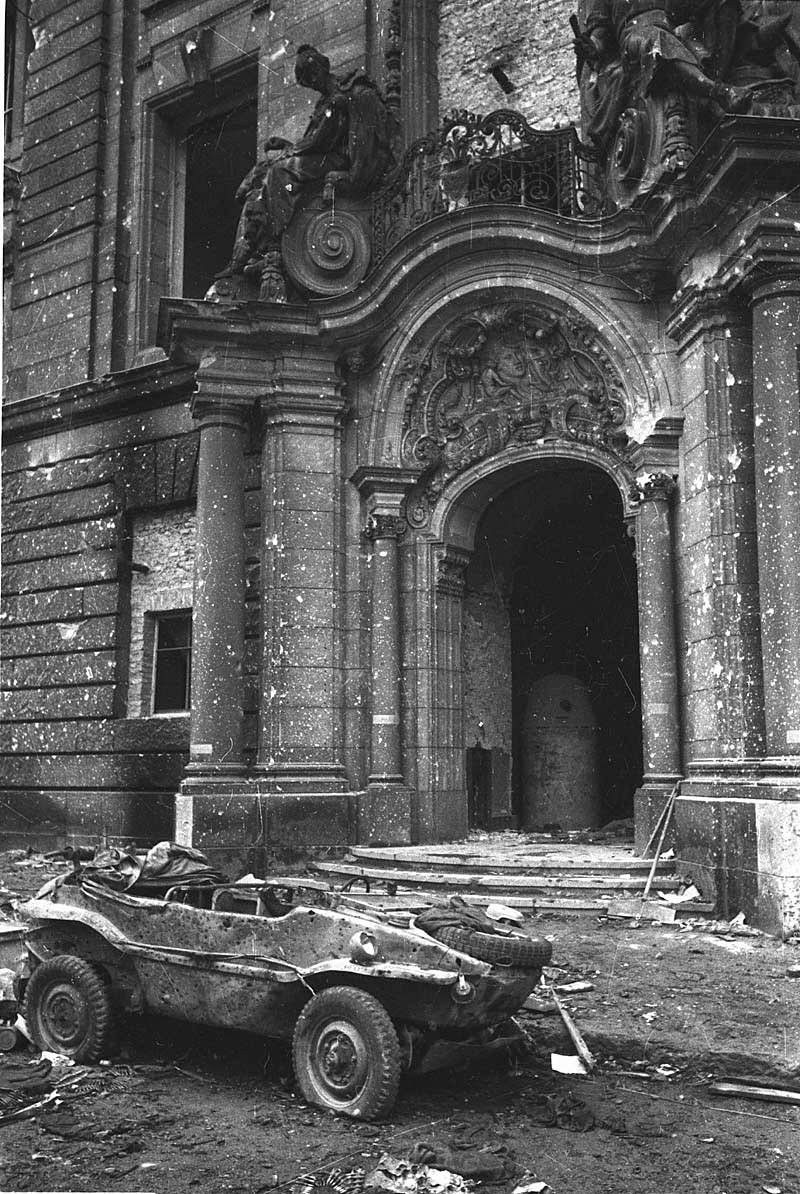
He came to recognize more and more that this war was not so much against a satanic force emanating from Adolf Hitler, but against the nation of Germany, its people, its high culture and its alternate vision of a finer world. He was slowly beginning to unravel so much of the indoctrination and propaganda that most of the allied troops were conditioned to believe in. A higher truth was beginning to edge its way into his thoughts and inner consciousness. Here was a man – a soldier- who originally believed he was fighting to defend his country from a Satan here on earth, when confronted with that other world first hand, began to realize nothing was as it seemed.
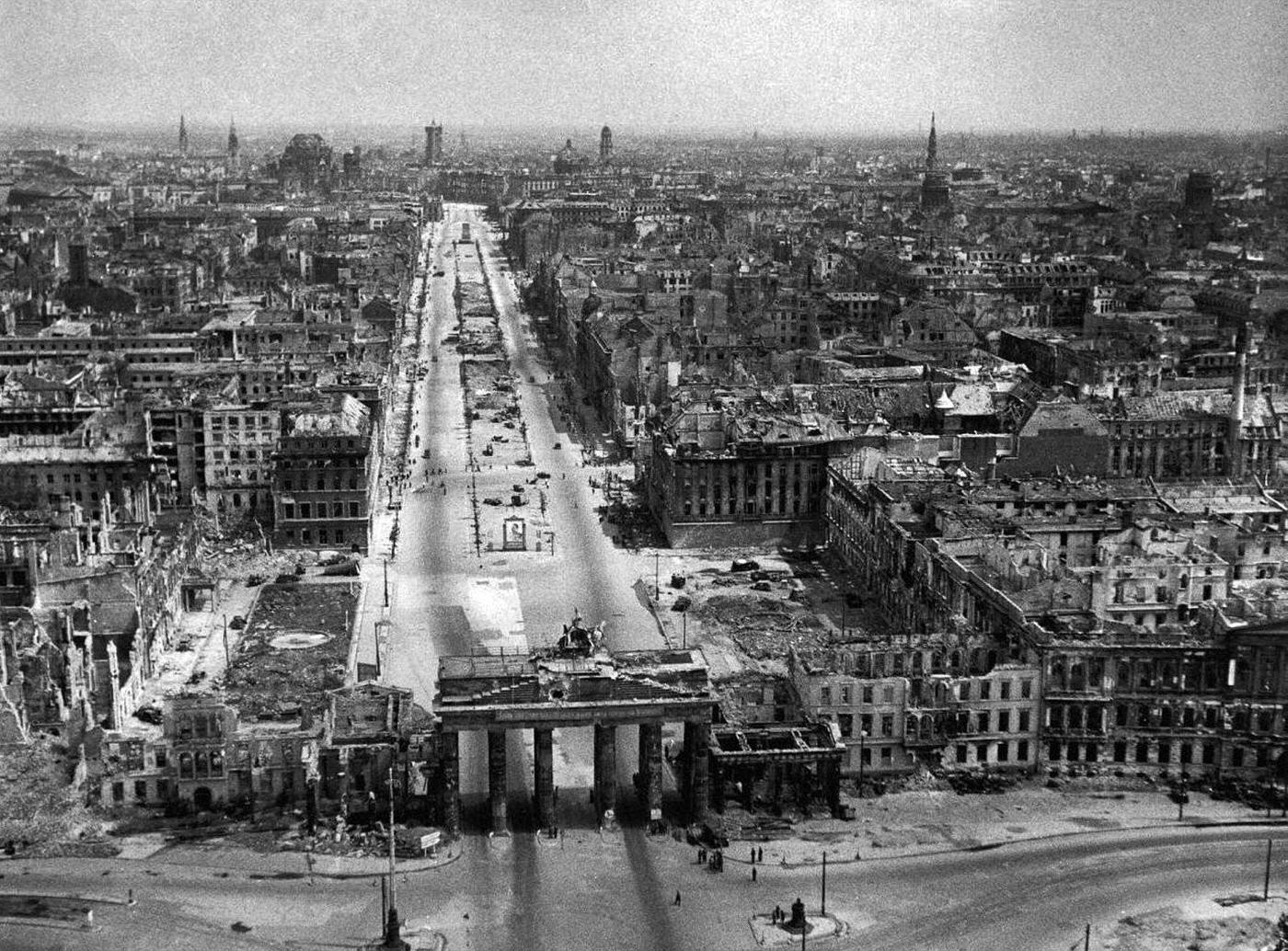
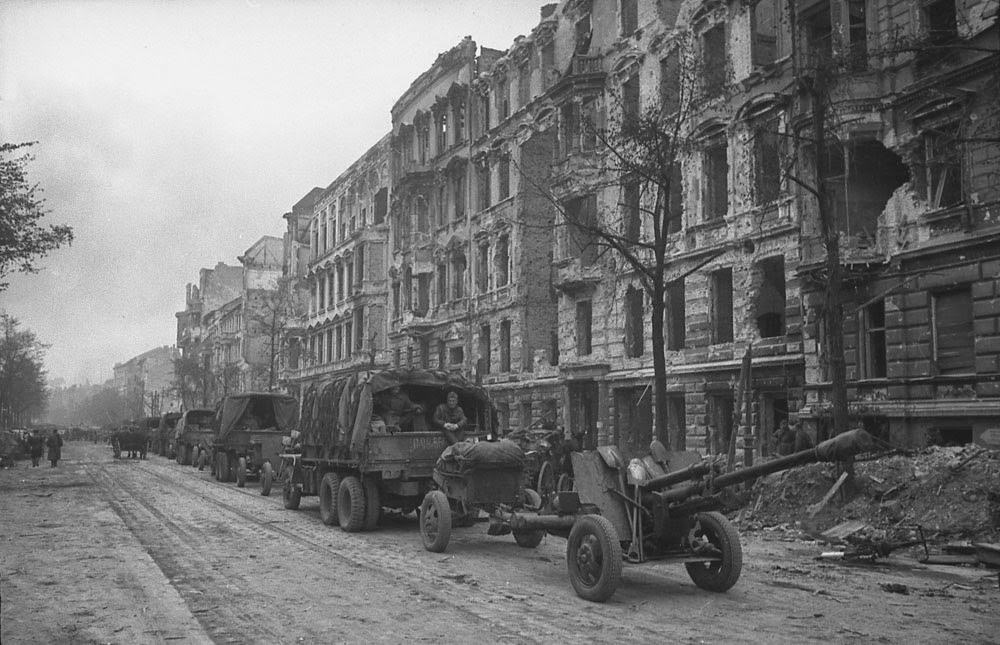
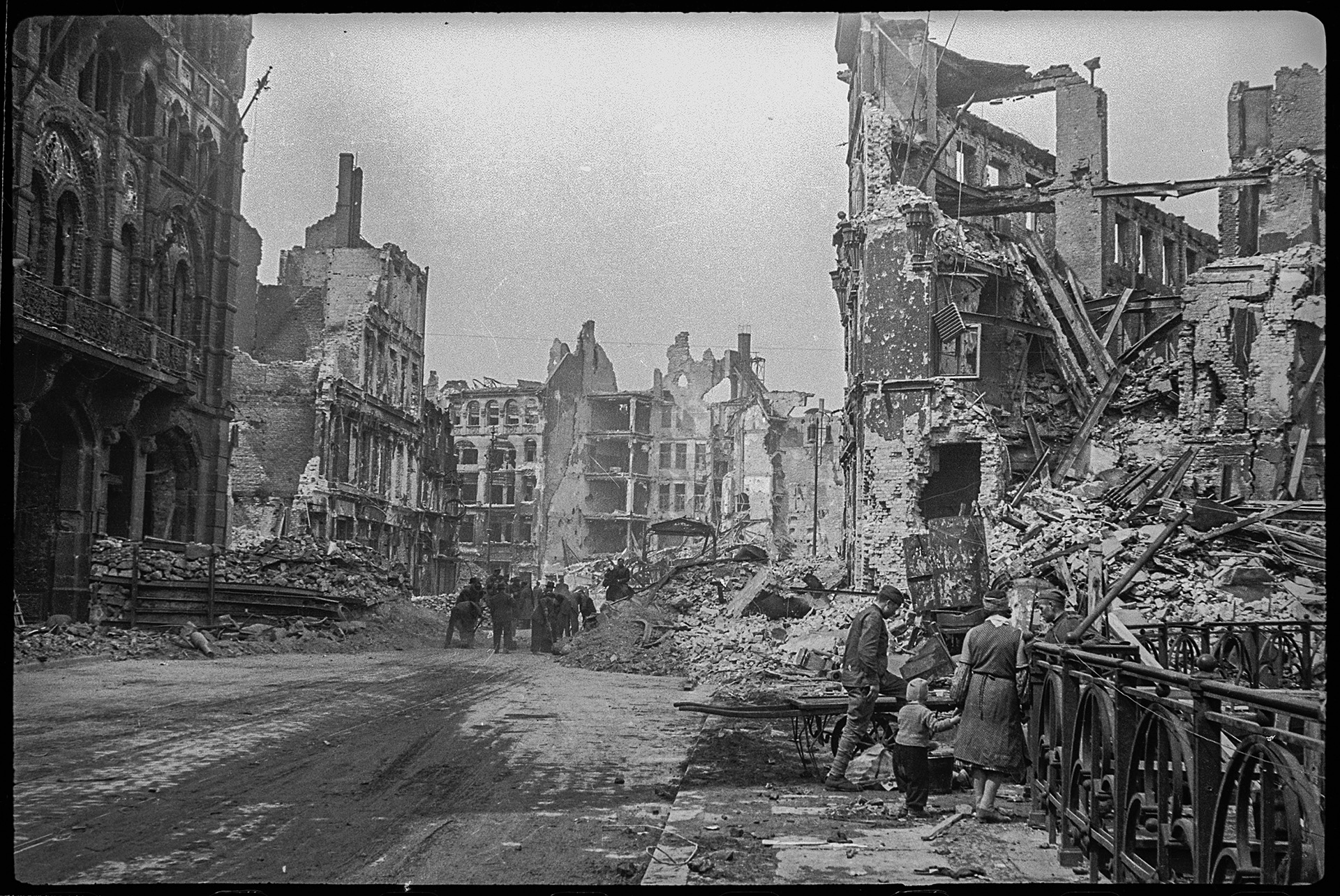
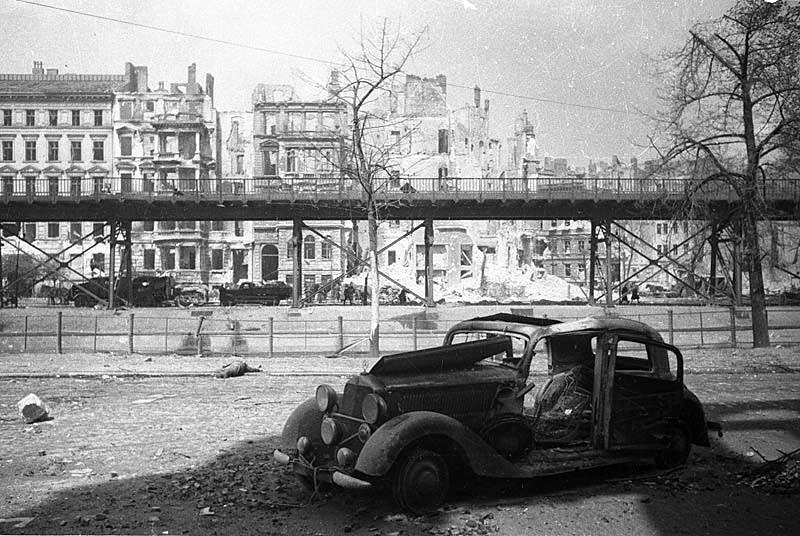
As our conversation moved forward he went on to state there were many towns, villages and major cities my uncle was able to visit once the war was near the end and after it was “officially” over. That other more deadly “after-war” clean-up, hell-to-pay phase was only just beginning. He was profoundly taken aback by the almost complete and total destruction of so much beautiful architecture and fine craftsmanship all within the civilian, non-military realm. He described walking along streets in bombed-out Berlin – once one of the most beautiful cities in classical Europe. There was one long stretch of boulevard where he recalled what seemed like an endless parade of burned out grand houses. The remains of enormous, old sidewalk trees lying splintered and torn apart from bombs dropped and the constant shelling. The hollow remains of once magnificent dwellings, elements of richly carved 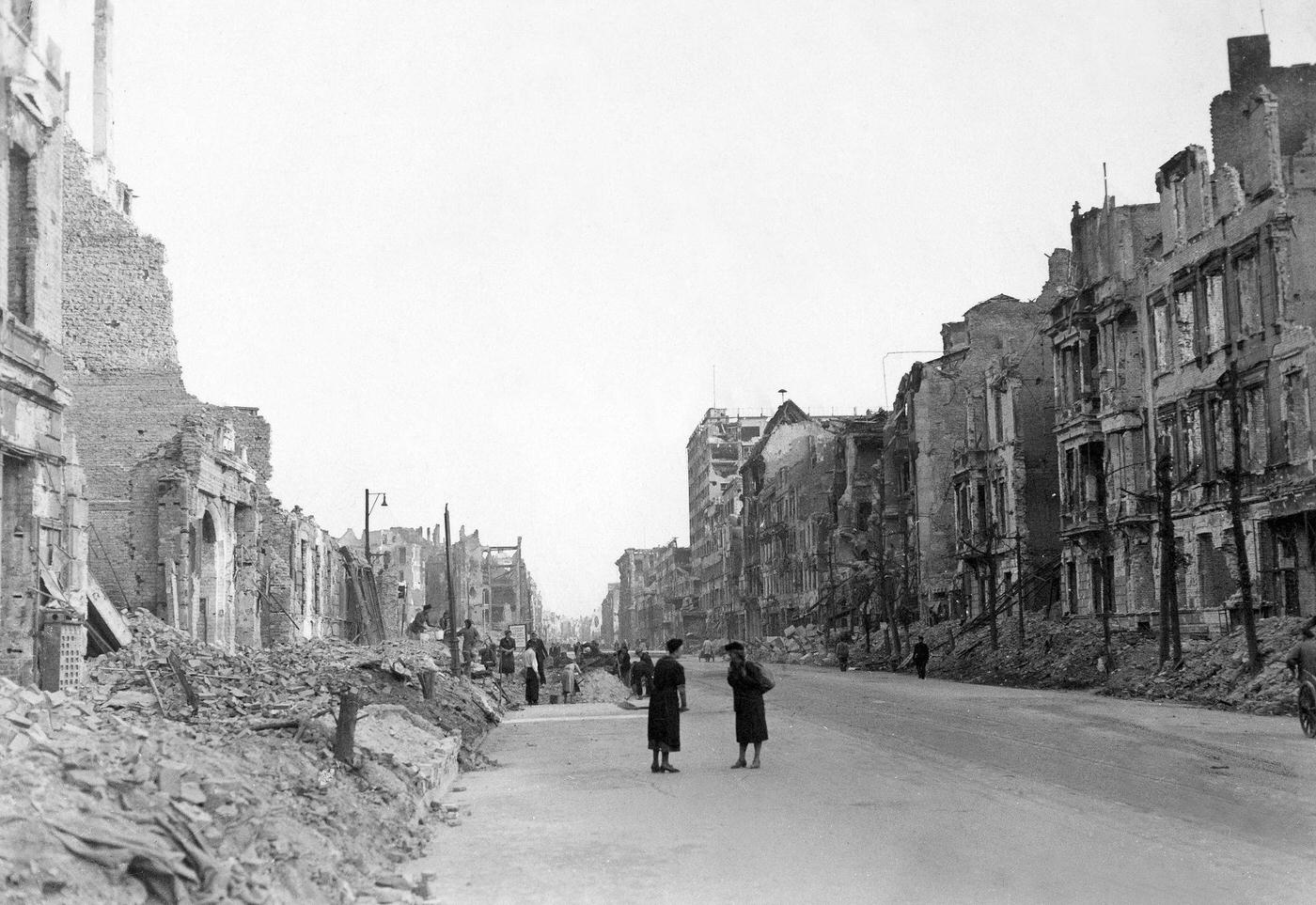 stonework facades still standing, windows and doorways that once housed magnificent interiors were now only burned-out shells open to the sky above. On one occasion he walked up the steps of one grand ruin in particular, marvelling at the intricacy of the surviving wrought-iron railing and the carved details of the exterior walls. He stood there at the threshold of the enormous doorway looking into what was nothing more than stark fire-marked masonry walls and tall chimneys rising above twisted metal, masonry rubble, and endless mounds of ash multiple feet deep, carrying with it the smell of incineration. He mentioned looking up at tall chimney stacks, some of them still holding onto finished, carved stone mantle details, that clung to the brick masonry. If this exterior masonry could still echo surviving details of such magnificent architectural grandeur, he could only imagine what exquisitely beautiful and finely crafted interiors that must have been. In our conversation he recalled thinking of all of the fine woodwork, fine plaster-work, beautiful furnishings, exquisite artwork, libraries and priceless family heirlooms incinerated and lost for all times. He thought of the life and lives that existed there, only a short few months before. Here and there, elements of once lovely gardens attempting to reassert themselves with leaves and blooms midst the countless ruins. And, worst of all, coming across the decayed, rotting corpses of pet dogs and cats and the skeletons of decaying carcasses of clothed
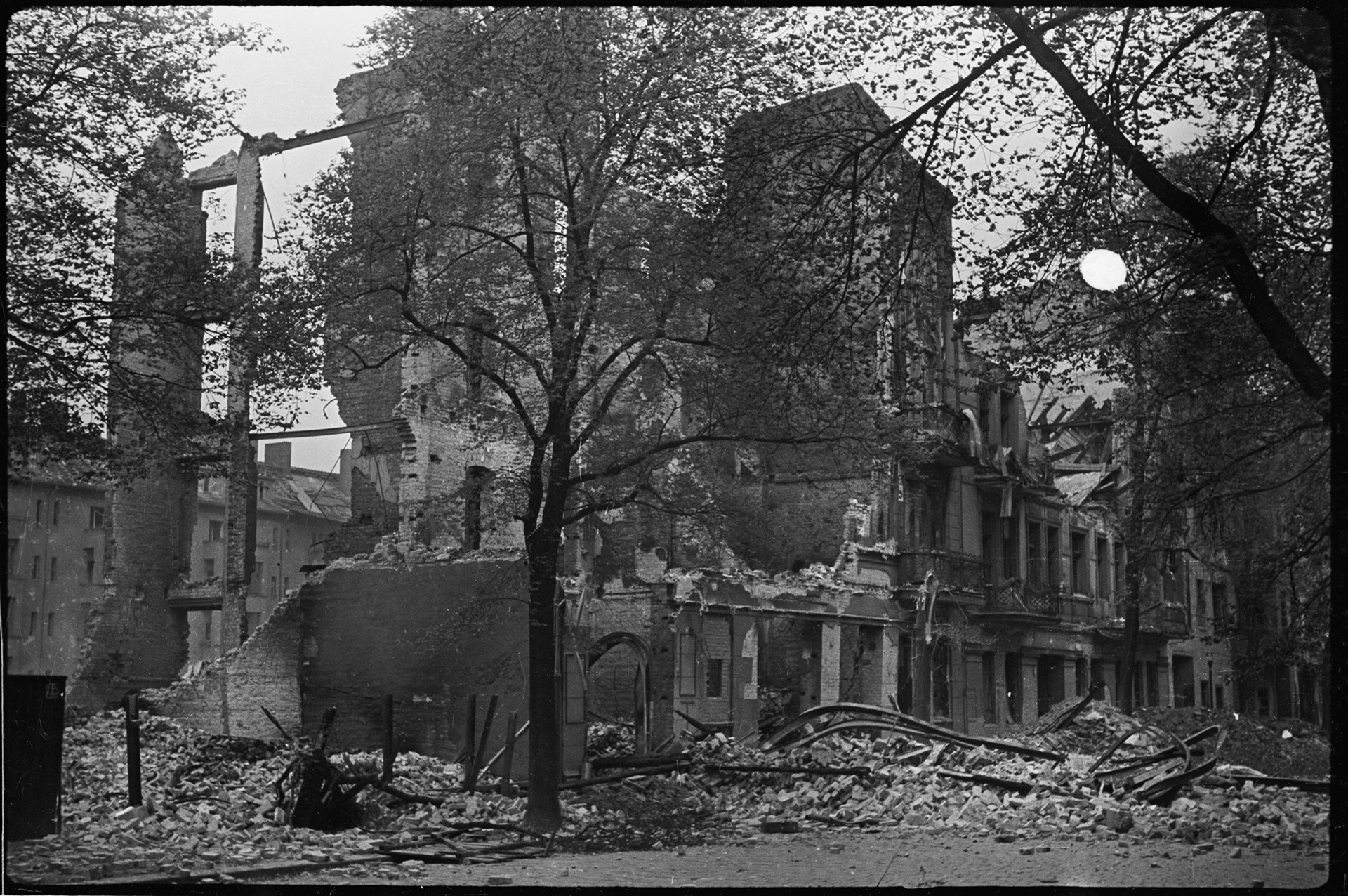 human bodies. He would stand there within what had once been lovely man made worlds now empty and devoid of all life. He also mentioned there were no real sounds of natural life. No birds, no insects – just that haunting silence, and smell of death and decay where once had been a life of richness and vibrance. Now and then a large flatbed truck would meander by the bomb-cratered boulevards and avenues carrying stacks upon stacks of the decaying bodies and skeletons of mostly dead German civilians. He knew this to be so because of the clothing they were wearing. The bodies were stacked so high, they had to be tightly roped down to keep the bodies from falling off (or falling apart) while traversing the badly damaged, rutted city streets.
He stated that he walked down countless avenues and boulevards lined with haunting ruins of magnificent buildings, commercial buildings, residential buildings, great civic buildings, churches, hotels, libraries, schools, and even once magnificent royal palaces – the surviving ruins still holding tangible clues to all the breathtaking craftsmanship, fine architecture and detailing that had been lost. He told me he felt so very, very ashamed and sick to his stomach. As I listened I thought of ancient Carthage and its total destruction by the Romans, the great civilizations of the Aztecs and the Incas and what had been done to them, completely destroying any physical remnant of their cultures, arts, writings and architecture. Just how could this be in the twentieth century? He stated he now knew there was so much more to this war than what we were led to believe. He did not fully understand what he was witnessing, but he stated emphatically this was not right – and in no way moral. He felt lied to, misinformed and cheated. Through patriotic manipulation he felt he had been conned into committing acts of wanton murder and genocide. He still did not understand for whom. But now we know it was all for the zionist/talmudic jews.
As nightfall descended and we approached the end of that most lengthy visit I was truly surprised when he told me that he made it into the “Hitler’s house” (the Reich Chancellery). I focused my attention intently on his every word. Although he stated the complex was badly damaged one could still safely walk through much of it. He approached through what had been the car court, or main entry for visiting dignitaries. The place, he said was a shambles, and more so due to extensive pillaging and wanton vandalism. Everywhere soldiers would carve their initials onto the exquisite marble and plaster surfaces. Chandeliers and fine furnishings smashed and hacked to pieces. He further surprised me by stating he had walked down an incredibly long grand corridor that led into Herr Hitler’s formal office. He remembered walking upon a rubble covered rug so large it nearly filled the entire room. He stated that the smell of urine and feces was nearly everywhere as soldiers seemed to make it a point to relieve themselves within these once hallowed spaces. There were also dried, splattered patches of blood here and there on the floors and walls—obviously the legacy from the shooting war inside from defending German soldiers. The large shattered windows opening out onto a ruined garden where here and there the lawn and various trees still attempted to green out and the occasional flowering shrub struggled to reassert itself with new seasonal flowers. He walked through the shattered windows out onto a large terrace overlooking the ruined chancellery garden. From there he walked past a large fountain pool where numerous allied soldiers were sitting and engaged in animated conversations. Attempting to approach a location further on within the shattered garden, he was warned off by several guardsmen. This, he was later told, was the entrance to an underground bunker complex and was off limits. Instead he walked on towards what seemed to have been a large ballroom space, now mostly wrecked, but still featuring intricate details and richly coloured marble columns. He further stated there were many soldiers walking everywhere within the trashed spaces, exploring and picking up little pieces of this or that to hold onto as their personal souvenirs.
I confess I sat there doing my very best to imagine myself walking within his own shoes those many years before. Believe me, I felt most envious as I have so long admired photographs of the chancellery, and here I was sitting across a kitchen table listening to someone who had actually been there, walked upon the floors where Herr Hitler had once lived, worked and entertained. He had lived and breathed it all in, where I could only struggle to imagine it. Yes, there was the obvious sadness and disgust I felt within myself for what we did to that most magnificent building, but to have at least been there! I felt both awed, and at the same time, ashamed of its fate.
Towards the end of our conversation my uncle expressed to me how deeply ashamed he was as to what the allies (and our people) had done to the German nation (his and my ancestors). For all those years thinking, and trying not to think about it, he knew we had committed a most unforgivable sin. Furthermore, he just could not wrap his head around the necessity of destroying so many millions of civilian lives and the magnificent art and architecture, so very prevalent and pronounced in that part of the world. Here was a wounded man who had lived it in a most painful and traumatic way. He knew what we had done, and it affected him profoundly in an intimate and personal way throughout his entire adult life. He could rationalize and “pigeon hole” only so much within himself over the years simply in order to maintain his sanity, meaning and purpose in this life. But ultimately he could never truly forget, perhaps at times speaking to those spirits of lives lost, asking for their forgiveness. The best he could do was to come to terms with it and live with it the best he could. I can well imagine the pains and sorrows he found it necessary to keep entirely to himself, and never having anyone to really share this with, to even begin to vaguely understand. No one else could truly fathom his struggle. At least I can take personal satisfaction in knowing that I helped him by finally being able to share with him so very much what he had kept hidden within for all of those many years.
Upon returning to the United States, he would never again see the land of his birth, its government and institutions, in quite the same way. He had been lied to all those years. With time, he stated, he would eventually burn or destroy anything that reminded him of that tragic and most violent period in his life, including his uniform, even finding it difficult to ever attempt to salute our nation’s flag. Without his knowledge, my aunt supposedly prevented some of this being lost, but so be it.
Towards the closing of our conversation late that evening he remarked how he could only imagine what the lives of those people, their families, etc. could have been had they been allowed to live their lives to the fullest without the burden of that most unnecessary war. I was dumbstruck to see him sitting there for the first time teary-eyed over the numerous lives he took. “Was it all really necessary?” Imagine all of the potentially great artists, philosophers, musicians, composers, teachers, scientists, craftsmen,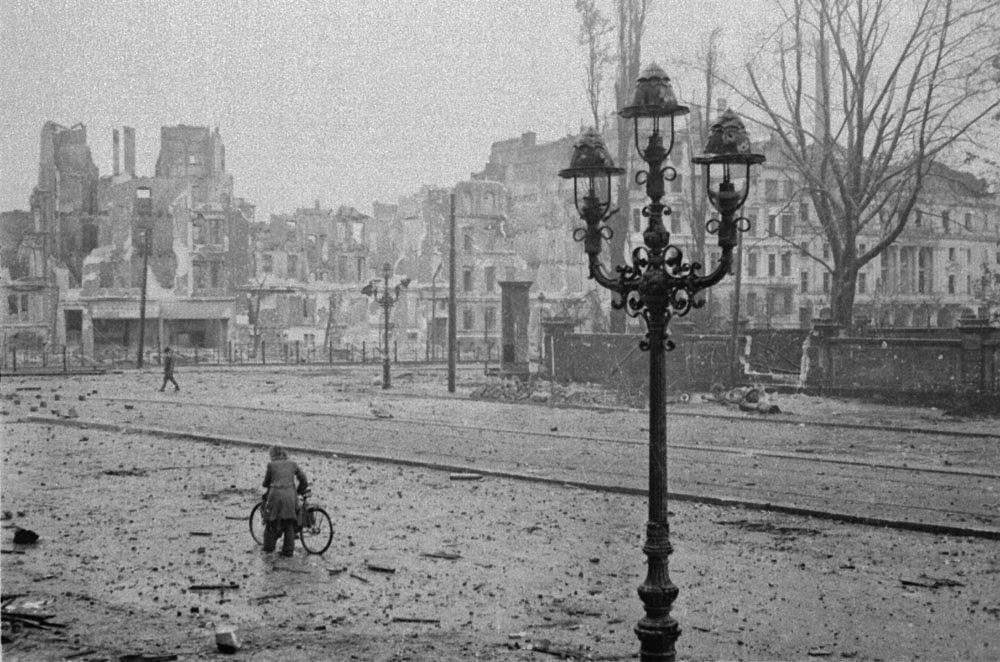 writers and poets who were lost to this world from that one tragic war. I, for one, could imagine the loss of those who might have gone on to become great architects. What great beauty we have been deprived of all of these many decades since! Furthermore, what great, beautiful, and inspiring German cities that still could be, had we not turned nearly all of them into heaps of broken rubble!
Since that conversation from forty-plus years ago I have had my own experiences here and there with numerous veterans from that era, primarily from the European and the Korean theatres of war. In past years I have found myself at times within the social company of two veteran friends of mine, they both having been in either the navy or air force in conflicts of a more recent date; think of the Middle East. On occasion I would be invited to accompany them to various VFW (Veterans of Foreign Wars) gatherings for an evening of drinks, darts and billiards. Talking and socializing with veterans who have been either in the army or marines, I have noticed that since they were the ones most likely out in the field in direct combat situations they saw and experienced the real traumas and intimate, direct hand-to-hand fighting, eye to eye and face to face. With rare exception, those I have met who dealt with personal combat situations, almost always struggle the most of any veteran. Their memories are the most brutal in nature. Similarly, in the past when I have had the personal privilege of sitting and talking with veterans of World War II, the one take that has set them apart from nearly all of the others, is the fact that they seem to me to struggle the most. Every one of them who has crossed paths with me have almost always been heavy drinkers and smokers. They seem to have the most to conceal, within themselves. Thus, I am inclined to believe at this point in my life that if young people fully understood what is really involved in combat situations they would never even begin to consider joining the military. No amount of money can justify what our veterans have to live through for the remainder of their lives. I know this was so for my late uncle. The mental anguish and physiological issues are enormous. Perhaps this explains why so many of them end up either committing suicide, drinking, and/or drugging themselves to death. I wonder if our nation’s politicians ever really think about this as they endlessly pontificate about the necessity of preserving American global hegemony. Then again, they are undoubtedly focused more on all that jewish money padding their pockets, allowing them to indulge themselves in that alternate universe of ego-stroking, status and privilege. Is there no shame?
Within a few months of my last conversation with my late uncle, I was pleased to discover he had met another lady in his life. They eventually married and my uncle sold the home he had built for my late aunt and their children – my cousins. We really did not ever talk much on that most intimate scale ever again, but we still shared that special “eye contact” at times, he now knowing that I understood. By that point I felt I had gleaned all that I needed to better understand his world and what was needed to help me better understand mine. As the nineteen eighties moved into the nineteen nineties, and thereafter into the new century I endeavoured to perfect my own world and my place within it. And, as someone who has constantly given myself to seek clarity and see through the falsehoods, and any and all ugliness, I feel I am better able to live with myself and find my place within this most magnificent God-given world, regardless of who wishes to degrade it, and exploit the humanity that lives within it. I have known for many decades now that it is primarily the zionist/talmudic jews (God’s chosen people) and the jewish mindset that is responsible for nearly all of our worldly problems today, and in decades and centuries past. I am deeply aware of their presence and the satanic evil they have permeated throughout our western world, our Christian values, and our European cultures.
In retrospect, we entered into a war that was completely and totally unnecessary. Furthermore, we saw fit to see killed and maimed so many of our nation’s fine young people, and those of our nation’s adversaries. A great nation, Germany, was crucified on the alter of jewish exploitation, manipulation and deceit that never should have been. Today they hold sway over our own nation’s political leadership from the federal all the way down through much of our local governmental structures, here and abroad. Our own nation, ever since, has found itself nearly totally subservient to jewish interests. What a truly profound waste of human, man-made and natural resources – all in service to a perverted ideological/economic/religious/satanic mindset that truly is a negation to all positive western Christian (and Aryan) values, including the love and respect for Nature and the natural world. Our founding fathers, as well as great figures such as Emerson, Whitman and Thoreau, truly must be turning over in their graves.
I will tempt fate and acknowledge here that not ALL jewish persons are bad – at least from my personal experience. I can state that there has only been ONE within my own personal and professional world who became something of a “father figure” to me over a period of nearly twenty years. He was a very prominent person in my former world. However, he often spoke to me about the most perverse jewish behaviour and the benefits he enjoyed simply by being born jewish – benefits that mere gentiles would never have been able to enjoy. He taught me a great deal as to what to be aware of, being a non-practicing type, although he maintained and cultivated those connections with his “tribe”. Well, why shouldn’t he have done so? It served him and his family well. He was the only, ONLY – jewish man who has never “screwed me over”, or even attempted to do so. And, I can think of numerous ones who endeavoured to discredit, besmirch and trash my good name, in business or socially, over the years, as I always refused to bow down before them and kiss their proverbial asses. He truly was the rare exception, and I am inclined to believe it was the better nature within himself, having native German blood, that those finer Aryan genes somehow prevailed.
In conclusion, and on a somewhat lighter note, I feel it important to end this essay by pointing out that ever since I was a small child I have always felt a deep, profound and abiding love and closeness with the natural world, the trees, the meadows, the native landscapes, the varied wildlife. Call me a “nature whisperer”. This natural world always seems to speak to me. Thus, whenever I am out and about within the varied landscapes, I never feel isolated or alone. But rather, in healthy communion with all of God’s creation. In contrast, the zionist-talmudic jews and their holier-than-thou “God’s chosen people” attitude towards nature and other peoples and cultures, seem totally at odds and in significant disrespect to our natural and man made world, always undermining and exploiting established cultures whenever they become significant in numbers here and abroad. Think of the “woke” culture now pervading our world – a direct result of their instigation and leadership. Again, think of their perverse, degrading influence on so much of modern art, architecture, music and the trashing of fine traditional community planning that once so handsomely characterized our nation. Furthermore, it has become so very clear to me just how much jewish economic and cultural behaviour amplifies and contributes to this collapse of our collective man made and natural environments. Consequently, I want nothing to do with most jews, for I see them as an unhealthy physical, mental and spiritual intrusion within my own sacred world space – and world view. Naturally, we cannot avoid all contact but I can recognize them for what they (mostly) are and keep them from infecting my own private and professional world too much. There are so many lessons to be learned here, should we proceed to further open our eyes (and minds) to what is happening all around us. I, for one, am not the liberal, nonchalant person I was when I was still in my early twenties. The wisdom and humility achieved through years of personal trials and tribulations have made me a far wiser, more poised and pronounced individual. I encourage all of you fellow Aryans who read this to do the same, for your physical and financial life and security just might come to depend upon it.
SEEK TO KNOW THE TRUTH
AND ALWAYS BE AWARE.
YOUR LIFE AND SECURITY JUST
MIGHT DEPEND UPON IT.
Mark Twain
~ ~ ~ ~ ~ ~ ~ ~



One Response
Christmas 1967. The clan with four generations. So as a child, I liked to sit with the adults and play mice so they would forget me as much as possible. I sat still and civilized to make myself invisible. The adults put on a cigarette and maybe drank another cognac. And then it was told. Casual. Events. Family histories. Secrets. This and that. I absorbed everything that came out of their mouths, I found it all so exciting, somehow richer than what was happening in my own life, and kept everything in my heart. When I look back to that time, I find everything in my heart. I smell the scent of cigarettes and alcohol. I feel the warmth of the room and its enclosure, the purity and coziness. Everything was festive and special. It’s a good thing I was a rather precocious girl who didn’t like joining the other children. So I heard these stories that weren’t really meant for me. I was particularly fond of the stories from very, very earlier. This lost world is just memory.
Susanne H. from Germany