This article was written by John Wear in 2017 and can be found on his website here: http://www.wearswar.com/2017/11/30/the-righteous-allies-starved-abused-enslaved-children/
We reproduce it here in full.
~~~~~~~~~~~~~~~~~~~~~
After Winning The ‘Good War’ The Righteous Allies Starved, Abused & Enslaved Ethnic German Children
by John Wear
“As we brought emaciated and apathetic children out and laid them on the grass, I believed that few would survive. Our physician, Dr. E. Vogl, himself a Jew who had gone through the hell of Auschwitz and Mauthausen, almost wept when he saw these little bodies. ‘And here we Czechs have done this in two and a half months!’”
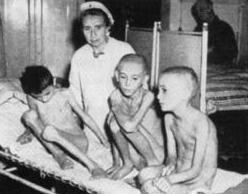
A British nurse in Berlin helps three German refugee children expelled from an orphanage in Danzig, now Gdansk. The boy on the left, aged nine, weighs 40 pounds and is too weak to stand. The boy in the centre, aged twelve, weighs just 46 pounds, and his eight-year old sister, right, weighs 37 pounds. This picture was first published in Time magazine on 12 November 1945.
Fate of German Children in Eastern Europe
One of the great tragedies of the 20th century was the forced expulsion of ethnic Germans from their homes after the end of World War II. One estimate of the Germans expelled runs to 16.5 million: 9.3 million within the 1937 Reich borders and 7.2 million outside.[1]
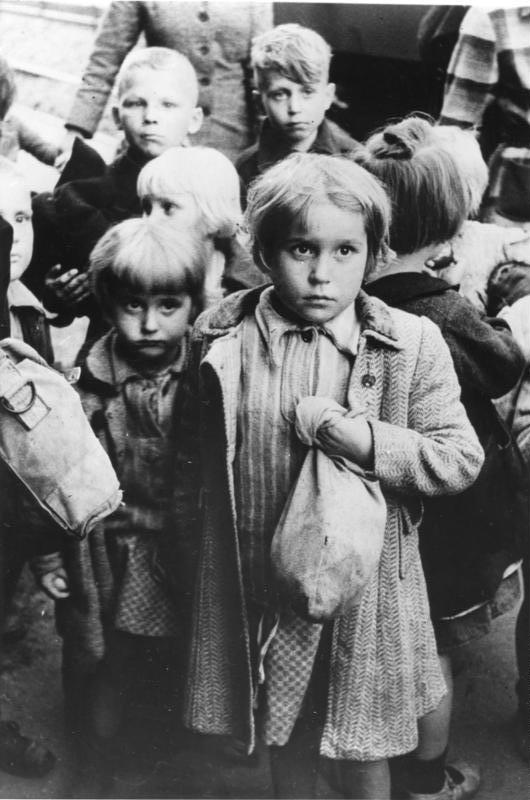
Was sagen diese Kinderaugen?
Diese deutschen Kinder sind soeben mit einem Transport aus den polnisch besetzten Gebieten in einem kleinen Ort Westdeutschlands angekommen. Zweifel und Misstrauen liegen in dem Blick der Mädchen – denn Heimat und Muttersprache sind ihnen noch fremd.
17.8.48 [Herausgabedatum]
Two little girls, one before and one after the full Allied treatment.
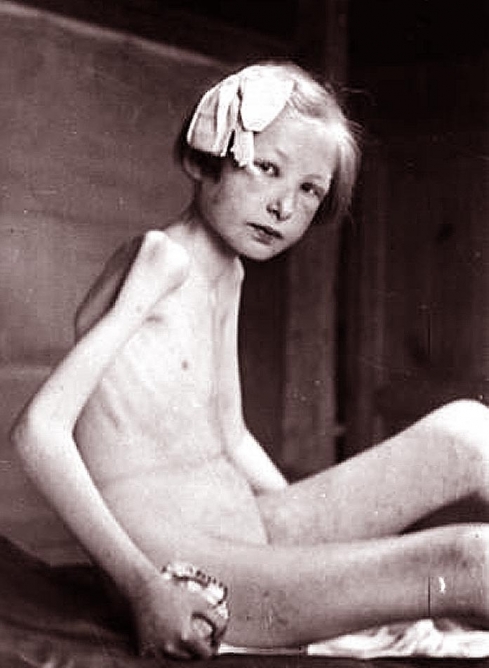
1945: “Intelligence officers of the U.S. Army, just returned from Germany, brought appalling stories of the conditions under the policy of divided control established at Potsdam last August. Berlin, they reported confidentially, had a pre-war population of four million and an average daily death of toll of 175. Berlin today, although harboring over a million refugees from what was Eastern Germany, has a population of just over three million; deaths, 4,000 a day.”
German children in Eastern Europe suffered major hardships and deprivations prior to and during the expulsion process. From August 1945, the Czech government allocated to German children under the age of six only half the allowance of milk, and less than half the allowance of barley, allocated to their Czech counterparts. German children received no meat, eggs, jam, or fruit syrup at all, these being allocated entirely to children of the Czech majority.
One example of the prevailing mood in Czechoslovakia toward German children was expressed by the Prague newspaper Mladá Fronta, which ran a ferocious campaign against British proposals to provide a temporary haven for thousands of starving German children during the winter of 1945-1946. When an announcement was made that the scheme would not go ahead, the newspaper’s headline read:
“British Will Not Feed Little Hitlerites: Our Initiative Crowned With Success.”[2]
In the Polish Recovered Territories, food ration cards were progressively withdrawn from the entire German population. Like their parents, German children found that they were entitled to no rations at all. The head of the Szczecin-Stołczyn Commissariat thus proudly reported that since the end of November 1945, even German children under the age of two had their milk allocation withdrawn from them.
Polish laws designed to protect German children were typically never enforced. For example, a directive issued in April 1945 by the Polish Ministry of Public Security specifying that nobody under the age of 13 was to be detained was never followed. More than two years later, the Polish Ministry of Labor and Social Welfare was complaining that the regulations against imprisoning children in camps continued to be “completely ignored.” German children were illegally detained in Polish internment camps as late as August 1949.[3]
German children experienced the worst conditions in the detention centers. Přemsyl Pitter, a social worker from Prague, quickly found as he visited the Czechoslovak detention centers that the overwhelming majority of those who needed his aid were ethnic Germans. At a makeshift internment camp in Prague, Pitter discovered at the end of July 1945 “a hell of which passers-by hadn’t the faintest notion.” More than a thousand Germans, the great majority women and children, were “crowded together in an indescribable tangle. As we brought emaciated and apathetic children out and laid them on the grass, I believed that few would survive. Our physician, Dr. E. Vogl, himself a Jew who had gone through the hell of Auschwitz and Mauthausen, almost wept when he saw these little bodies. ‘And here we Czechs have done this in two and a half months!’ he exclaimed.” Officials of the International Committee of the Red Cross (ICRC) found that the conditions at other Prague camps were no better.[4]
The youngest German children were most vulnerable to the conditions in the detention centers. Their undeveloped immune systems and lack of physical reserves left them particularly vulnerable to starvation and its attendant diseases. A credible account by a female detainee at Potulice in Poland recorded that of 110 children born in the camp between the beginning of 1945 and her eventual expulsion in December 1946, only 11 children were still alive by the later date. A high rate of infant mortality in the camps was also caused by numerous cases in which German children were denied medical care because of their ethnicity.
Investigations by the ICRC found high rates of infant mortality attributable to malnutrition to be widespread in Czechoslovakia. When the ICRC visited a detention center in Bratislava at the end of 1945, it found that every one of the emaciated infants and children was “suffering from hideous skin eruptions” and that conditions were “in general so desperate that it is difficult to find words” with which to comfort the detainees. A journalist from Obzory, who visited one of the Prague detention centers in the autumn of 1945, acknowledged that “mortality has increased to a horrifying degree” among the children. The journalist attributed the high mortality among the infants to the complete absence of infant formula and the fact that the majority of nursing mothers were too emaciated to breastfeed their newborns.[5]
Authorities generally did little to shield children from the harsher aspects of camp life. Germans in Czechoslovakia typically became forced laborers on their 14th birthday, with some districts requiring labor services of those aged 10 or above. At Mirošov in Czechoslovakia, the definition of “adult” for forced labor consisted of all inmates above six years of age. Children of 10 years of age and above were also routinely used as forced laborers in Yugoslavia.

In September 1945, the ICRC complained that in the Czechoslovak camps the young male guards treated detainees with “the utmost cruelty,” with widespread beatings of children as well as adults. Many children were also subject to psychological abuse, and some children were compelled—as at Kruševlje in Yugoslavia—to witness their parents’ torture or execution at the hands of camp guards.[6]
The Western Allies did not intervene to help ethnic German children in Eastern Europe since they regarded all Germans as perpetrators of World War II. The policies of the Western Allies and the expelling nations were a violation of their subscription in 1926 to the International Declaration of the Rights of the Child, which stipulated that children were to “be the first to receive relief in times of distress” without taking into account “considerations of race, nationality or creed.”
German children were also denied aid from international relief agencies like UNRRA and the International Refugee Organization (IRO) as a matter of policy. Even the UN International Children’s Emergency Fund (UNICEF) maintained a discriminatory stance against German children, assigning priority to the children of “victims of aggression” in the provision of aid. The plight of children in the expelling countries was additionally worsened by the expropriation of German religious and charitable organizations, which caused German children in orphanages and facilities for handicapped children to lose their homes. In the long run, the only hope for most German children in the expelling countries was their expeditious removal to Germany, in-spite of the difficult conditions they were likely to encounter there.[7]
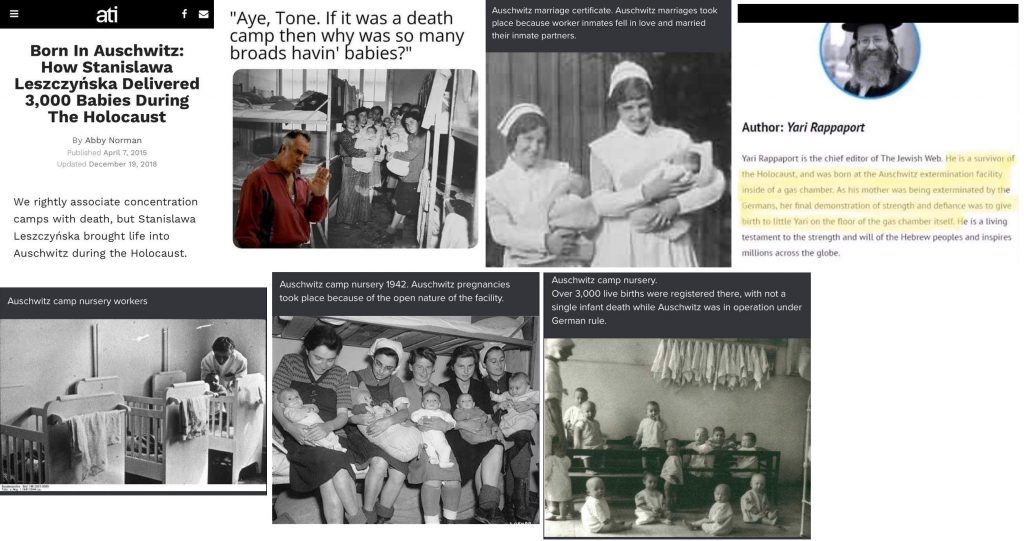
In contrast Jewish babies and children were well cared for in Auschwitz until saturation bombing destroyed Germany.
ENDNOTES
Image: German child refugees from Poland
Images: Little Girl With Ribbon in Her Hair 1945 and News-article
[1] MacDonogh, Giles, After the Reich: The Brutal History of the Allied Occupation, New York: Basic Books, 2007, p. 162.
[2] Douglas, R. M., Orderly and Humane: The Expulsion of the Germans after the Second World War, New Haven & London: Yale University Press, 2012, pp. 233-234.
[3] Ibid., pp. 234, 236.
[4] Ibid., pp. 234-235.
[5] Ibid., pp. 234, 238-239.
[6] Ibid., pp. 234, 236-238.
[7] Ibid., pp. 240-241, 244.


8 Responses
Dear Monika,
I believe the most touching and telling feature of this particular article concerns the photographs of the abused children. In this case, words really have no say in the matter. One really has to condemn both the character and conduct of the “adults” responsible for this hideous, savage abuse of so many countless “young ones” who cannot for any justifiable reason be held responsible for living in that wrong time and in that right place. The first time I reviewed this article I was immediately (and painfully) reminded of the many stories my late uncle shared with me during his time in the war in the European theatre. It was like sitting there and once again having him describe to me the horrendous abuse, raping and murder of countless German women and children at the hands of his fellow American servicemen. As you know, I described much of what he shared with me in the one fairly long letter I mailed to you in the latter part of last year. I can once again see him sitting there in his kitchen teary eyed while sipping his beers and whiskeys and puffing away on his cigarettes – the images still so very fresh within his mind after a good nearly thirty years that had passed for him up to that time – a solid, well-built man some six foot, two inches tall and weeping like a scared little child, crying out for forgiveness. All of the flag waving, patriotic diatribes and political howling dumped on him still could not erase from his memory the unforgivable sins we had committed in the lands of our forefathers – a country (and continent) we were told we were “liberating” from the evils of “National Socialism”. Honestly, liberating from what? Seriously, for what purpose?
As you know, I am now in my early seventies, quite well educated, versed, thoughtful and proud of my own legacy within the realm of art, architecture, historic preservation, landscape design, the study of history, etc. Still, I cannot fathom to this day how our ancestors from that period of time could so completely misjudge events within their time and there place within the larger scheme of things and fall prey for the many countless lies, deceits and distortions of reality our varied leaderships were foisting upon the masses. It most certainly took me quite awhile to fully grasp the profound evil extent just how much manipulation(s) and control by the jewish diaspora really had already achieved up to that time over our people and our nation’s thinking. I suppose I will always remain confused, bewildered and confounded to the extent such hideous mindsets really have dominated our modern world, then and now.
I do not believe I have ever told you this, but in my junior year of high school back in 1969 I entered a writing competition in the Literature Department to compose an essay on any subject matter I was told felt relevant to me at that time. I chose the subject of what caused the outbreak of World War II. Sticking entirely with the facts even relevant to me at that time I discussed the causes as to why Germany went into Poland to end the Polish slaughter of what had been up to that point over sixty thousand innocent German men, women and children trapped within the redefined German borders handed over to Poland as a result of the Versailles Treaty signed at the end of World War I. It was a lengthy essay and I clarified that it was not Germany that started the war but Britain, followed by France. In addition, I delved into those first several months after the declaration of war, further discussing Herr Hitler’s repeated attempts to accommodate both Britain and France to no avail, attempting to come to a peaceful resolution of the conflict.
On what was a Friday afternoon two weeks later I handed in my completed and nicely typed, finished essay, which I was very proud of for its thoroughness and attention to various details, including quality white paper stock, front and back white cover sheets and a black plastic binder. Foolishly, I really did believe at that time I had a good chance of at least gaining some appreciation for my work. Well, guess what happened? Upon entering my first morning class in Trigonometry & College Algebra Mr. Hanes, my instructor, handed me a note informing me I was to go immediately to the principal’s office. Once having arrived at the Administration Building (it was a large campus with various buildings for different subject matters) I found myself immediately escorted into his office where the Literature Department head and my instructor, Ms. Brennan, were seated and awaiting my arrival. Unbeknownst to me, my subject matter in the essay had created a “firestorm”. It was like I had committed a terrible crime of some sort – an insult to the memory of our dead, perhaps. I repeatedly asked for clarification as to what I had done wrong. Their answer never was truly clear to me beyond the fact that I had explored a subject matter that seemed to have been “unpatriotic” and/or slanderous to our country. Looking back now in hindsight that really was an unforgivable “no, no”. The principal thereafter handed me back my paper and I was dismissed to return to my class. My participation in that writing contest was thereby terminated.
Even to this day – over a half century later – there is so very much we are still not allowed to question, or even discuss in “polite society”. That singular event was the first real moment when I began to open my eyes and realize our world was/is not what it seems to be. An “official” narrative had been thus thoroughly established by that time, and it remains officially to this day.
Frederick
Dear Frederick,
Thank you for sharing your essay-writing story. Weren’t we told that going to school will give you an “education” and you will learn valuable skills and you will learn about history and you will learn how to be good citizens? My goodness, nothing could be further from the truth. Pure indoctrination centres! And it has only become far worse. Now the schools literally encourage the maiming of children and keep it secret from the parents. All I can say to parents is please keep your children far away from public schools. But I digress from the subject at hand. Thanks again for your comment.
Ich kann nicht anders und muß weinen, wenn ich diese gequälten Kinderseelen sehe. Mein Herz dreht sich im Leibe um.
Wie viel Glück wir doch hatten: Zwar waren wir 1946 Vertriebene, doch wir haben unsere beiden Eltern behalten!! Wie viele
haben ihre Eltern verloren oder 1 Elternteil! Ja, gehungert hatten wir auch, aber nicht so krass. Meine Eltern, meine sieben
Geschwister waren unser Halt. Unsere Mutter starb mit 100 Jahren; sie hatte nie Zeit zum Kranksein. Vater starb mit 84 J.
Oft habe ich meinen Eltern gesagt, wie viel Glück (trotz Armut) wir doch hatten und alle gesund waren. Danke, Gott!
Liebe Herta,
danke für ihren bewegenden Kommentar. Mich bringt diese Geschichte auch zu Tränen. Besonders schlimm ist es, daß so viele Deutsche immmernoch an der teufeligen “Umerziehung” leiden.
Monika
It is important to recognize the repeating pattern. During World War I, the Allies also attempted to hand over the German people to starvation. The totally illegal and genocidal naval blockade by the British at that time lasted 4 years, during which vital raw materials and food could not be imported. The famine winter of 1916/17, due to the war and due to crop failures, in which only turnips were used as food, was vividly remembered by all adults. At that time, quite a few people, especially children, had starved to death. Malnutrition resulted in these children being up to 5 cm shorter and malnourished, suffering from many more diseases, including rickets and tuberculosis, than the previous generation. The number of deaths from starvation is estimated at 424,000 after World War I. After World War II, there are no figures due to the chaotic circumstances. The children were often traumatized by bombing, escape, neglect, hunger, and cold. I myself know from personal accounts two infants who starved to death after the Second World War. My cousin and aunt became so seriously ill with tuberculosis that they were treated in a lung institution for months. Fortunately, my great-grandmother owned a dairy business, so my grandmother was able to grow up without hunger after World War I. My paternal grandmother lived in a working-class housing estate with a large plot of land. She could grow her own fruit and vegetables and earned money by sewing whites, so she supported her five children and many grandchildren through the difficult times. The other grandmother had it even harder because she had to bomb out of Hamburg and then flee from the Russians. She managed to get her two children and her elderly mother through. There were already times of a certain degree of starvation for all of them.
Susanne H. from Germany
The automatic translation doesn’t always pick up the right terms, so please excuse the occasional confusion. I’m dealing with it as best I can.
Liebe Monika, ich habe es mit Google Translator versucht, aber es scheint, die Ergebnisse sind für Englischsprecher auch nicht überzeugend. Wenn ich den deutschen Text eingebe, verändert das Programm den Text oft so, daß er auch nicht richtig gut verständlich ist. Was ist Dein Eindruck. Ist es besser, mit dem deutschen Text? Ich könnte Dir natürlich auch meinen deutschen Text als Email schicken und Du redigierst ihn. Aber das macht Dir viel Arbeit.
Herzlich Susanne
Dear Susanne, sometimes when I open the comments on the dashboard of this website, there is a feature which gives me the choice to view the comments in German or English. A few times I’ve used that translate function, and it turns out more or less okay, but I notice some errors. Another time I have taken your comment and copy-and-pasted it into deepl and then posted the English one as a “reply” to yours, so the English-speaking world would have the benefit of reading your fantastic comments.
I can try to do that from now on, and even go back to your previous comments and translate them, but that might take a while, because as you say, that is a bit of work.
So it is better that you post your comments here and not by email, because that will add another layer of work for me to post them to the correct article. I’ll do my best to translate your comments here.
Thank you for all your comments!